Showing posts with label STEM. Show all posts

Tuesday, November 11, 2014

I am thinking about writing a book....

I am thinking about writing a book but am not sure of a few things.

  1. Do I have enough great ideas to fill a couple hundred pages? 
  2. Would people want to know about the aforementioned great ideas?
  3. Can I write a book on STEM education that doesn't put readers to sleep after 5 pages?
  4. Can I get anyone to read 5 pages?
Anyway, my thought is to try to put something together on what it means to teach STEM through solid instructional practices and coherent content. Kind of a STEM teaching 101 in terms of what is out there right now. What are teachers talking about in science teaching, math teaching, technology teaching, engineering? I am thinking of something along the lines of what would happen if an industrial arts teacher talked with a math teacher, who talked with a science or technology teacher. I think the pedagogy they have are defined as different, but fundamentally similar. I have a brief outline and have started on the prologue. I am not sure if my tone would be accepted by publishers of educational texts, but I really believe that I can put some useful facts and ideas between well-placed puns and admin jokes. 

I would really appreciate some comments on this one as I could be on to something, or just thinking of putting in a lot of time for nothing. Here is some of what I have so far in a very rough draft form. I would be expanding on may of these ideas with some research to back up my ravings.  If you are saying, "Hell that needs a LOT of work to be published" you are right it does. This was written in a single sitting and needs some serious re-writes. My hope is that you read it and say. "Hell, that needs a LOT of work to be published, but with that work, I would like to read more."


STEM BOOK
(working title, duh)

Prologue
I have a vision of the year 1500, where a young 17 year old Copernicus comes home late for dinner. I imagine him wanting terribly to see what was outside Prussia, asking his parents repeatedly for a vacation to the Mediterranean. I see him, a normal teenager, fighting pimples, getting in trouble with his brothers and sisters, and begging his merchant father for that ornate codpiece to impress that blonde in his morning arithmetic class. I wonder if his parents ever had enough of his questioning? I can see them exclaiming, “Copernicus, you need to realize that the Earth does NOT revolve around you!”
I am pretty sure that is how the renaissance started, even though I have no evidence to support it. Regardless of it’s origins, the renaissance did gave us some great characters to admire and emulate. It gave us Galileo and Descartes, live-action role playing (LARPing) and names for our ninja turtles. It gave us paintings of naked angels, sculptures of naked men, the demotion of our own planet (sorry Pluto, your time was coming), and a method for systematically doing science.
Before the Renaissance, it was Aristotle’s world. As far as “natural philosophy” was concerned, if Aristotle didn’t say it, it wasn’t true. For a couple thousand years our world ran on the ideas of the man who created logic. He was Einstein, Hawking, Brad Pitt, and Jesus wrapped into one. If you dared have an ideas that was contrary to his ancient Greek philosophy, you might as well pencil yourself in for a Saturday with the Inquisition....and don’t plan anything for Sunday. If you don’t believe me, ask Galileo how it turned out for him.
Fortunately the noble and courageous efforts of the people of the Renaissance developed a method for dealing with Aristotle’s logic. Premises of arguments were renamed “data” and inferences were labeled “hypotheses”. The last natural philosophers developed and refined a process they called the scientific method. It outlined a step-by-step process for solving problems that people observed around them. It has given us cures for diseases, trips to the moon, and an understanding of the fundamental pieces of the universe.
The world has run on the principles of these dead white men for 600 years. It is time to rethink our understanding of what science is and how it is done? Today we have new technologies, engineering and mathematical understandings, and teaching techniques that fit together with science principles like the Mendel’s peas in a pod. It may be time to throw back the curtain and examine what science has turned into and how it is being taught.

How you should read this book.
First off, realize this soon to be classic literature you have in your hand was not intended as a judgement on what is currently understood or taught in science classrooms across the nation. It is offered as a frank look at what is currently happening in our scientific culture and schools, coupled with some fifty-cent jokes and puns I got off Twitter (#notreally). It is my hope that first and foremost, the quips are interesting enough so as to grab your attention long enough for you to get a hold of some information that will alter or reinforce an opinion you have about teaching and learning science in our schools. I am not offering this as gospel, simply some observations where you can draw your own conclusions.
In preparing for this book, I of course, did a comprehensive study of the relevant literature. In fact, I typed “science STEM teaching” into Amazon and read a lot of summaries… okay a few summaries…. okay I looked at some titles and decided that people may want to read a book that doesn’t put them to sleep. I have lot of books, or really a lot of pages in books that I haven’t read. I usually get through the first couple of chapters and realize that the twenty minutes I just devoted to this read was really a waste of time. I want to right the wrongs of the dozens of pristine, yet dust covered pedagogical texts that line my office. I have decided that if I am going to put my time into writing this, it should be something that you may enjoy reading. I know it is a novel idea.
I offer to you the 10 Commandments I am putting forward to myself in writing the next two hundred odd pages.
  1. Thou shalt back up any claims with evidence
  2. Thou shalt not rely heavily on research that has not been tested and peer-reviewed
  3. Thou shalt not covet another Acronym other than STEM (it’s in the title)
  4. Thou shalt not create a new pedagogy that is really just renaming someone else’s work and calling it thy own to sell a book
  5. Thou shalt not be boring or tedious
  6. Thou shalt give teachers ideas they can use in their classroom tomorrow
  7. Thou shalt think of three other commandments before I finish this book.

Making an Acronym
Scientific advancements alter history; it comes with the job, like lifeguarding and skin cancer. In 1957, a group of Russian scientists (many captured from Germany after WWII) shocked the world by designing a large ball that beeps and placing it on a rocket. Sputnik changed the world by metaphorically sticking up it’s large metallic middle  finger at the United States. That doesn’t sit well in the land of the free. Up to that point, the US had been the leader of the world in science and technology, punctuated with two atomic bombs to remind the last country that messed with us who was on top.  
America does not play second fiddle to anyone, our ego is too large for that. The flags rose, trumpets blared, and the battle cry was again sounded for America’s scientists to answer our collective id’s call for vindication and the space race was on. President Eisenhower led the charge with a radio address where he heralded,
Of course, free men are meeting and will meet this challenge. Up to a point, this must be done on the Communists' own terms--outmatching them in military power, general technological advance, and specialized education and research.”
President Kennedy took the reins of the scientific stampede and put a man on the moon in the 60’s, a feat that would have never been possible without the Russians throwing down the space gauntlet. America’s workforce was again churning out scientists and engineers at an alarming rate.
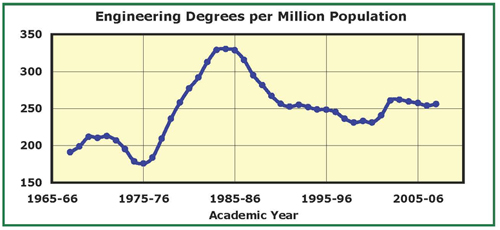
Wow, look at the early 80’s! It is no wonder there were so many advances in areas like  walkable music and nylon pants. Many of the engineers and teachers in those times were getting their degrees paid for through programs funded by the government, special interest groups, or industries trying to keep up with rising tide of American scientists.
Then the floor fell out. We won the space race, flew the Voyager probes, and were left twiddling our really smart thumbs. Schools began to realize that by supporting teachers getting advanced degrees in sciences brought with it a very big problem. Teachers got advanced degrees in science! They were leaving teaching and taking jobs in industry, leaving schools back at square one. Colleges stopped offering programs in hard core science disciplines in favor of advanced degrees in ‘science teaching’ and ‘instructional technology’. It was virtually impossible for a teacher to get an advanced degree in science in the early 21st century. Lab classes were not offered during the evenings, and core classes were not offered during the summers. Professors were doing their own research during this time and could not be bothered by people who already had their own jobs.
Then the information age hit our world like a dino-killing asteroid. Jobs were being created that no one could predict would exist, let alone prepare students. Isaac Asimov could not predict the number of web designers and dot com companies that were popping up across the country. Money was being made, technical skills were being awarded, and schools were again trying to crystal ball what they should be teaching. They tried new approaches, innovative lessons, and teaching pedagogy, all restrained in their model of schooling that had proven itself worthy through the last two hundred years. 

What are schools to do when there is a demand for scientific and technological skills tied to math and engineering practices? Schools were asked to help shape the world again, so they sharpened their pencils, laced up their gym shoes, and accepted the challenge. When faced with such a demanding problem, the National Science Foundation in the 1990’s responded with a method that they had formulated refined for over three decades. They created an acronym!
STEM
STEM stands for Science, Technology, Engineering, and Mathematics. That is a large order for a simple set of letters.........


Imagine then a long dialog into defining what STEM is fundamentally, etc, etc, etc. What do you think? Give it up or keep writing? Are you intrigued enough to read more of my blabber for a hundred or so pages? I am open to all feedback, constructive or the kind that rips a man's heart out and steps on his hopes and dreams;)

Chris
@christopherlike

Wednesday, May 21, 2014

STEAM- New Buzzword, or Game Changer

In the fall of 2014, I was hired as our district’s STEAM coordinator. As May of the previous school year comes to a close, I find myself in front of my science classroom for the last time. I was trying to explain to them that they would have someone else teaching them AP Physics next year as I was taking on curriculum duties as our STEAM coordinator. I will never forget that look of confusion on their faces in part because after I tried to explain the acronym, I found that same look painted across my face.


I got nervous fast. While I was jacked to be starting this new journey as our district’s STEAM expert, I couldn't deny that a part of me had no clue what I was getting into.


I had a problem. What exactly is STEM? And where the hell did this A come from?


Science, Technology, Engineering and Mathematics, that is STEM, or at least was my definition at the time. I was a physics teacher, highly respected in my field, and very successful with students. I had to be doing this already, didn't I? Science is in fact the first letter, that had to mean something…. there was math in physics, and engineering and technology too! I had this locked, no problem.


Then I started to think about it some more. What exactly is science? The running definition in my head was that it was a method for understanding the world around us. It began with a research question then utilized data to find relationships between variables. There were graphs, equations, definitions, and statistical significance that led us to understanding how we evolve, or how stars blow themselves up. Science was my bread and butter. Toss me a scientific law and BAM I am there with a fifteen minute lecture... Dalton's Laws- no problem, Newton's equation- cake walk, anthropic principle- I can dig it. If it is one thing I am comfortable with, it's science. Bring it on, STEM, I got your first letter locked!

T?


I had a professor once tell me that a chalkboard is technology. It is a device used to help us. So is a broom, and a telescope, and a computer. Everyone gets so caught up in tablets, apps, presentation software, and smartphones, that they seem to miss out on what technology really is. A rock was technology a couple million years ago when you wanted to open a coconut. Learning technology is about troubleshooting a device to make it work for you better or more efficiently. It is not only computers, it is about sharpening that rock.


If the rock doesn't work, bash the coconut against a tree. Now you are talking like an engineer. If science starts with a research question, engineering starts with a need to be addressed. How similar is that?! Engineers solve problems, they make our lives better. They develop technology, sometimes to answer a scientific question (oh the connections). There are construction engineers, mechanical engineers, chemical engineers, aerospace engineers, and even food engineers. They see problems and they solve them. They may be putting men on the moon, or just giving them something to drink while up there (I am looking at you Tang).


A friend of mine from a close university, a physicist no doubt, once told me that we should not bother teaching high school students science. He said that is easy. We should be teaching them more math and some computer coding. Those, he said, were the language of science. If a student came to him at University not understanding the Law of Partial Pressures, he could probably talk them through it. However, without math skills, and to an extent coding, he couldn't even hold a conversation with them. Math was the language of science. Graphing, equations, statistics, and probability were essential in all disciplines of science. Without a firm understanding of math, a science lecture may as well be spoken in Greek.


So what is STEM? I think it depends on who you are talking too. To an educator, we are looking to mold students into thinkers, innovators…. the superhero leaders of tomorrow’s industry. We are striving for another (or first) Tony Stark, or would even settle for a genius super villain engineer. We know that technological innovation and advancing science will drive our nation’s economic growth and keep us competitive globally. We want to prepare students for fields that are not even invented yet. We crystal ball a future where workers use the letters in our acronym consistently and interchangeably to solve our world's problems. We have growing problems of not enough space on this rock, fewer and fewer resources and energy. We know in the back of our minds that the human race can not continue to expand at the rate we are making babies without altering the ways in which we do things. The problems will be there, we just don't know what they are right now.


Industry has a different definition. They could care less about the future; they need workers right now. They need problem solvers in jobs they can’t fill today. They need workers with technical skills, math ability, troubleshooting experience, and work ethic. They need employees who can work in a team, towards a goal. They need a workforce with STEM skills.


Surprisingly, politicians and lawmakers actually find themselves more in line with educators on this, at least to the extent of agreeing on the goal of STEM. They see it as a pathway to economic growth and global competitiveness. Sometimes their policies don’t quite match with an educator’s goals, but their intentions are at least blatant.  


Then there is the A…. Where did the A come from? If STEM was not enough, we are adding the Arts into the soup. Pushed by the Rhode Island School of design, this capital A is probably the my biggest worry. I sat in a lecture last year at our state science conference where a professor did a study of Nobel Prize winners and other various intellectuals. As it turns out most of the great thinkers of our age were very vested in some kind of art or design field. It was the first time I had heard of STEAM. To me, the fact that Einstein played a violin doesn't hold a lot of validity in an argument for including the arts in STEM. Then a few weeks ago I was introduced to the Wallet Project out of Stanford’s college of design. First off, I didn't even realize that any college of design actually exist. Once I left the workshop, my perfectly designed foam wallet in pocket, there was no doubt in my mind that design and the arts are an integral part of innovation.


So here I sit, trying to piece all this together into what STEAM means to me, to my district, the teachers I work with, and the students I work for. Putting the pieces together reveals a picture that is both grand and awe-inspiring. The theme of innovation is interwoven through problem solving by design. Using complex skills, content, and processes our students will someday move this world forward. It is our job to prepare them for what is out there for them right now as well as what has not been thought of yet.

STEAM is a buzzword. It's a pathway toward funding, resources, and a link from schools to industry. It is all-encompassing, and yet strictly defined by a set of principles. Many I speak with say we are already doing these things; we just have not labeled it with this decade's lingo. I believe that is true to an extent, but the doors an acronym can open are extensive.

Please share your comments below.

Chris
@christopherlike

Thursday, April 24, 2014

Leaving the Classroom

I am leaving the classroom.

I am currently teaching my last set of students.

Today I am giving my Unit 2 Astronomy exam for the last time, tomorrow I will be introducing my Galaxy Fleet Gamification for the last time.

Dennis asked me for a pencil to take the test... that is probably not the last time.

It may sound as if I am leaving with a heavy heart and I can not deny that that is true. I will miss the kids, I will miss their stories, their worries, their struggles, the relationships I have not yet built. There is something special about having a classroom full of students to help guide through exciting times in their lives. I would not have gotten into this profession if I didn't believe in kids. I know I have made a difference in specific student's lives. They have told me and that is probably the most endearing compliment a teacher can get.

I am not asking for sympathy, I chose to leave.

My district was awarded a grant to develop a system for teacher leadership. I have accepted a position as our district's STEAM coordinator and I can't be more excited about the possibilities this holds. Unfortunately this position has pulled me completely out of the classroom, to which I regret, but the work ahead of me is both exciting and new.

I will be working with teachers, not directly with students. Can I develop the same kind of relationships with adults that I have had with kids? Probably not, but I plan on giving it the old college try!

What does a STEAM coordinator do? I am asking myself the same question. As this is a new position, I have the daunting and exciting task of defining the job. Having not worked a day in the position, it is hard for me to say what can be done, but I have some goals.


  1. I plan on coordinating curriculum K12 in all aspects of STEAM. Not only making sure that the levels (elementary, middle, and high) are sequenced, but set to standards and measured appropriately. I believe I will have a unique perspective in being able to see more cross-curricular connections between all aspects of STEAM. (I have some ideas about having our elementary gym teachers measuring times for runs and then kids calculating their speeds. Can you imagine that, doing math and science in gym class?)
  2. I plan on bringing the community into our schools. We have very strong community support for our school and I plan on capitalizing on that. Lets bring in some engineers to work with some of our classes or clubs. Lets get students networking with industry through internships and job shadowing. 
  3. I want to increase the participation and availability of STEAM activities after school. We have a strong commitment at the high school to our science club competitions. I would like to see that expanded to our other levels. We have a respected team at middle levels in lego robotics. How can I help bring that the to high school? What can we do at the elementary level?
  4. I plan on training our teachers in both content and pedagogy to help them meet the standards set by the district. Some of our elementary teachers are not comfortable teaching science. I plan on showing them that science is fun, engaging, and an avenue to teach reading, math, and thinking skills. Teachers at all levels need exposed to what is new in teaching methods. We have flipped classrooms, modelling, learning cycles, 1:1, and a myriad of other models to put in our teaching toolbox. I plan on giving them exposure to what works for them individually. 
  5. Technology at all levels is ever changing and teachers need to be brought up to speed on its best use. 
If there is one thing that I don't lack, it's ambition. (In my spare time I plan on curing cancer and working on world peace) These are the goals I have set for myself. They are lofty, but they are important. I can not accomplish these alone. I will need help from the great teachers around me, and you, whoever you are that took the time to read this. If you are a teacher, please share your thoughts on what you would like from a STEAM coordinator. If you are already in this position, please contact me and we can share ideas. 

It is an exciting time for my district and me personally. To accomplish these goals will take time, patience, and a lot of endurance. However I will have 8 hours a day, every day to work on this. When I look at all that I do in the classroom in terms of planning, grading, delivering, and collaborating on instruction, these 5 seem more than workable. Perhaps I will have to add a few more goals:)

Chris

Wednesday, December 4, 2013

Should Iowa Adopt the Next Generation Science Standards?

This last fall, I was given the opportunity to sit on an Iowa Department of Education task force looking at the question of whether my state should adopt the Next Generation Science Standards in place of our current Iowa Core Standards in Science. The committee consisted of about 20 people from across the state who represented various interest groups. There were some teachers, students, parents, professors, STEM coordinators, DE people, and even a congresswoman or two. After three meetings in Des Moines, I can tell you that the group of professionals called to action in this committee were at the top of their game. I have the utmost respect for each of them and their opinions (even those I disagreed with). They were passionate, without an agenda, and highly concerned about the direction Iowa should go in terms of it's science standards. In the end, the committee voted to recommend that Iowa does adopt these standards, but there was some hesitation in many members.

That being said, let me give you my thoughts, reservations, and hopes for our state.

I went into this thing a blank slate. Overall, I am not the biggest fan of standards in general. As I have said before, I believe that they stifle creativity for teachers, limit student choice as to elective classes, and rarely fit with what I think should be taught in high school. But.... as we are stuck with having to adopt something, I was willing to give them an ear and keep an open mind.

Spoiler alert: I voted that the state should adopt, but I had reservations. Let me explain my thoughts here.

Why the State should adopt:

In looking at a comparison between the Iowa Core and the NGSS, there were a few distinctions that stood out in my mind. First was the research they were based on. I am not a fan of educational research in general, (its all soft science) but am aware that there are many out there that know more about it than I do. Both of the standards documents are research based. The NGSS follows the Framework for Science Education published in 2012, which was based on the last decade's research in how science should be taught. The Iowa Core was based on the original National Science Standards document that came out in the mid 80's which means the research behind it was probably done in the late 70's. This was before we had computers! Score 1 NGSS.

The second interesting fact about the Iowa Core came when a panel of the actual writers sat before us. They were understandably proud of their document. They spent hours of their life in working through its intricacies, and themes. However, there really were only a handful of them, and they had other jobs. They consistently told us that if they had more time, money, and support, they would have developed something similar to the NGSS. I am proud of a lot of what I write, but I know that if I didn't have a day job and could devote my time to, say this blog, it probably be funnier, and make a lot more sense than it does.

Third was the PD piece. The Iowa Core, to me, was not implemented with fidelity. Our state had switched gears to many times, altered what they wanted, and finally failed to assess anything. 2013 was the year where science was supposed to comply with the standards placed in the core. Most of us teachers are completely surprised we made it this far. Many science teachers tried to put our heads in the sand and wait for it to go away. With the NGSS, you can't do that. It calls for a complete revamp in what is taught, when it is taught, and how it is taught. This scares the hell out of me.

In the end, it is my hope that the State of Iowa does adopt these standards in their entirety. The NGSS is not designed to be a document that you can not take apart and use pieces and parts. It is a full curriculum of standards that demand integration of the disciplines traditionally held apart. To do this, however, calls for a strenuous change to the current status quo in science teaching. Are the teachers, administrators, and state officials in Iowa ready or willing to make this change? Is the political climate that surrounds these kinds of decisions too charges for our legislators?

Please comment on your thoughts below.

Chris
@christopherlike

Monday, November 18, 2013

What I Don't Know...and Some of What I Do

I was recently asked to post to a blog we are using in my building. I thought I would share it with anyone reading this blog as well. 

For more posts from teachers at Bettendorf High, click here.

Enjoy


What I Don't Know...and Some of What I Do


Confession time…..

I don’t know where I stand on climate change. There I said it, what a relief! I have read a lot of scientific articles, looked at a lot of graphs, know quite a bit about scientific principles that govern such things, but even with all of this background I am still unable to make any kind of firm stand. What is even more interesting though, is that it doesn't bother me. Let me clarify that.  If the glaciers are going to melt and drown all of Florida, I do care. (#Disneytripplanned) What I am content with is my ability to say that I haven’t developed an opinion. As it turns out, I am completely undecided about a great many things. I don’t have firm stands on ethanol production, string theory, or if Snookie should have been kicked off of Dancing with the Stars (#neededtogo). On these examples, I am comfortable saying that I don’t know the full story on the environmental impacts surrounding ethanol plants, the mathematics for a universe with 13 dimensions, or why it is important to keep your toes pointed when performing an Argentine tango. It is not that I don’t care about these topics, in fact I do a great deal. Its just that right now I do not feel that I have the background on these subjects to make an informed decision… and THAT’S OKAY. I refuse to feign a belief in an idea if I am not educated about it (#notapolitician).

Ignorance is bliss.

It truly is. I am not talking about stupidity, or a blatant disrespect of basic facts. I am a firm believer than in order to develop an opinion, one has to do the research. Content is an integral part of schooling and learning. I am talking about the unknown. I am referring to being ignorant of the unexplored, the unimagined, or the mystifying. This is what interests me; this is why I learn… and given enough interest, there is nothing I can’t learn. I believe our students also crave mystery more than rote learning. The unknown is a crucial part of schooling that I think doesn't get enough attention. So often, we as teachers fall into the trap of treating our profession as a delivery system. The kids sit in plastic seats and we feed them information. At this, we are experts. We add garnish to our lessons with flashy technology, code it with pedagogical jargon, and celebrate any tiny upward variance in standardized test scores.


Where does the unknown fit in? There is still a lot of the world that we are truly in the dark about (Yeah, I am looking at you gravity.) When a bunch of physics teachers get together to chat, we don’t discuss Newton’s Laws, we talk about what we DON’T know. Give me quantum gravity, neutrino fluctuations, or the rules regarding an Oxford Comma and watch the cognitive party start! Last night my son and I spent 30 minutes discussing why mayonnaise sales have grossly outnumbered salsa in the US. Who knew? (#ketchup3rd #getinthegameheinz) Discussions about what you already know doesn't yield anything. I am constantly focused on what I don’t know. Now think about topics kids are truly ignorant about.

Lucky for us, most students are truly ignorant about a great many things. (#quoteme)

Finding ignorance is not a problem for teachers. The problem we face as teachers of all levels is at some point in time, their natural curiosity about the world was diminished. They don’t even care that they are ignorant. That’s the problem. I want to learn, I want to grow, I want to hear your point of view. When or why are our students losing this drive? Why are they so complacent in their development?

How this has happened, or why it happens can be argued. As I have the keyboard here, I will give you some of my take on the matter (#feelfreetodisagree). I think that this push for standards, state and federal control of curriculum, and the external pressures placed on teachers are strangling our system. Teaching is, by its nature, creative. To be effective, curriculum needs to be adaptive, based on teachers’ strengths, and as individualize to students’ needs as it can be. While trying to corral curriculum into state or national standards may look good to a politician or administrator, it looks completely different from someone on my side of the desk. I teach to a student, not a standard. It is a human endeavor, not mechanical. Jane isn't just taking Physics, she is taking Like’s Physics. There is no best way to teach, there is no silver bullet for learning, no utopia that we can achieve that will reach all students. At no point in our future will we “figure education out” so that it works like a well oiled machine and never has  to be looked at again. What we have are good people running against the wind in an uphill job.

So what could this look like? We hear a lot about how we are failing our students nationally and how things need to change. Rarely does anyone tell us how to do this. Today is the day, friends. As I have a captive audience (#youreadthisfar), I will give you some of my ideas. Again, these are my thoughts on a Wednesday afternoon, and may change by Monday.

1) Don’t be afraid of a good argument with students. Often times we shy away from these kinds of things as they can get heated or tiresome. I find that these situations can lead to my most memorable lessons. Remember though, that there are different ways to argue. The classic argument involves a war model: you yell out your side to the high hills until you either win or concede. But there are other ways to argue. Why does there have to be a winner to an argument? In math and science we argue differently; we argue for proof.  For example, I have been altering many of my labs in physics towards what we call a “modelling” approach. Last Monday, my students took data on variables that affect the period of a pendulum (#classiclab #stilladisaster). Before we drew conclusions, I made them whiteboard their results and share their theories with the class. At this time, I basically argued with them over their data. How reliable was it? Are you sure you can back that claim up with evidence? I don’t care what you feel about what should happen, what does your data say? I am not being belligerent, I am being a scientist. At this point in the semester, it brings me the greatest joy when they start to hold each other accountable and argue amongst themselves.

2) Don’t be afraid of alternative points of view. When talking about evolution, how can you leave out intelligent design or catastrophism? Why broom these under a rug? Why don’t we look at data and let the students draw their own conclusion. If 99% of scientists have reached the same decision, shouldn't your students reach it as well judging the data? It baffles me how you language arts teachers deal with poetry, or art teachers with interpreting Picasso? Sometimes there is no right answer.  I think there is a lesson to learn for us teachers as well. A very bright young teacher I know brought up over lunch one day (#bestplaceforPD) that things like blogs, twitter chats, and FOX News are really creating a dichotomy in our society. If all I watch are the same news shows, or read the same blogs (present blog excepted), I am only reinforcing my beliefs, not challenging them. Try posting a diverging comment to a blog or chat. They will crucify you! The people who read these blog are usually of a like mind and don’t want to hear views that are not supported by their peers. They have been preaching to the choir for so long, that their beliefs are cemented in their minds as a dogma, instead of a conceived fluid idea. This gets compounded when you realize that search engines and news feeds run algorithms that only show you articles that are similar to what you have already read. Google perpetuates this! Teachers take heed and diversify your PLN. Invite differing opinions and don’t be afraid to share yours. (#I’mnot #soapbox)

3) Ignorant people ask questions. This is good. Push them to ask why things happen, why are you teaching them this, or why is it important. As I said before, I am ignorant about a great many things, but my ignorance breeds a drive to question. It seems that the more you know, the more you don’t know (#Yoda?). PhD’s do research; we pay them a lot of money to find questions that have never been asked before. If you think that doctoral diploma means they have it all figured out, you probably have not worked with too many of them. If our goal as teachers is to impart the knowledge students are going to need to be successful, we are fighting a losing battle. When I went through high school we didn't have the Internet! How could my teachers prepare me for today’s world? We need to train kids on how to question effectively and back up their claims with evidence, even if we disagree with their conclusions.


I am a teacher. Of all the professions that I could have chosen, both then and now, I still believe my place is in front of kids. It may be close to the hardest job in the world; one of the most scrutinized, underpaid, and underappreciated, but it is what I have devoted almost two decades of my life too.  I know a lot of teachers and I can tell you that I have never met a single one that did not give it his/her all, in school and out, for his/her students. I have the utmost appreciation and respect for everything that you do, from the papers you publish in journals, to the small comments you leave on the margins of your students’ term paper. Please, if there is anything I can help you with, let me know. Also, if there is anything above that sparks your interest, please leave a comment below. Feel free to agree with me, but especially feel free to challenge me. 

Chris
@christopherlike

Friday, June 28, 2013

Next Gen Science Standards, a Need Unfilled

I had the opportunity to hear Dr. Steven Pruitt speak at Iowa's kick off of the Next Generation Science Standards (NGSS) this spring. Now, those of you who know me, or have read any of my earlier posts, should know that I am both the theorist (the talker) and the engineer (the doer). I seek out innovative approaches to teaching by lurching blogs and twitter like a squirrel in a bush hunting nuts. But like the squirrel, I am finicky. I won't eat anything. I also don't like to be force fed. Right now I am trying to decide if these standards, were tossed before me by Cinderella, or laced in poison.

Enough with the rodent analogies.

I am by no means an expert in these standards, but from my cursory study of them, along with my visit with Dr. Pruitt, I have come up with some opinions. 

1. Dr. Pruitt surprisingly makes a lot of sense! He stood before us for eight hours on a cold Iowa spring day giving more than 200 educators an overview of the history and purpose of the standards. He spoke of the need for commonality, the research background underlying then standards, and the intricate politics (or lack of) that went into the decisions made in their development. All in all, he made very good arguments, had research and reality to back up his claims, and was not afraid to tell us the shortcomings involved with their development. I left there trusting that the guy knew what he was talking about.

2. Dr. Pruitt made a lot of sense to 200 educators. I can tell you that, even with my BS glasses on, I came out of that day sipping the Kool Aide. If his goal was to get Iowa's educators excited about the standards, mission accomplished... if Iowa only had 200 educators. My biggest worry on the long drive back to Bettendorf, was how I was going to spread my enthusiasm for what was coming down the pipe. When I got home, I quickly realized that this was going to take some time.

3. Science is not Biology, Chemistry, Physics, and Earth/Space science. This was the brightest epiphany for me since that day. It was not Dr. Pruitt, but a particle physicist I know from Coe College that happened to be at the kick off that drew me to this realization. I had worked with Dr. Ugur Ukgun for several years, where he has led me though the intricacies of quantum theory and experimentation. That day, however, he wore a teacher hat. He had been engrossed in laboratory work at the University of Iowa for over a decade while getting his doctorate. Now he was looking for the brightest minds for his own labs. It hit me that this is the guy I am preparing my students for! I needed to pay attention. He said two things that strung a chord with me. He talked about scientific research as being non-denominational. He didn't consider himself a particle physicist, or even a physicist. He was a scientist. In his work, he needed very high level chemistry, astronomy, cosmology, and three other scientific disciplines I had never heard of. Science was not a set of classes, but a way of thinking about nature that is cross-discipline at its very nature.

4. Math is a language, science is a method. The other point that Dr. Ukgun made was that if a student was weak in science, he could work with them. If a student was not proficient in the language of math, he couldn't even talk to the student. Math is the language of science. He believed that if high schools focused more on math (and with that computer programming) they could pick up the science concepts later. This was rather humbling to me as I have devoted many hours to teaching kids science, but his point had some validity.

5. Performance expectations are not the same as standards. They don't just tell us what students should learn, they dictate what students should be able to do. They have the odd feel of Hogwart's potion making class. I am working on my contempt glare ala Professor Snape when a student's potion blows up in their face. I am joking of course, but there is an element of performance assessment that is inherent in them. My problem with performance assessment is that I am not ever sure how to ride the line between pass/fail and giving students too many points for "trying". I guess I will have to look into this. When I figure something out, look for a post:)

6. Lastly is the "Need Unfulilled" aspect of this post. Dr. Pruitt made it exceptionally clear that these performance expectations are not curriculum. They are not intended to be "how to teach", just end results. This is where the teacher comes in. I applaud his committee for giving us reign here to play to our strengths and devise what we feel effectively matches our strengths and individual student's learning styles. However, the amount of work needed to make this change is daunting.

Thus I call to you all again. I am going to be fighting through this for the next few years. So are many of you. Join me in the conversation about how this these standards are interpreted into daily work. I am "phoning a friend" so to say so that we can talk this over, hash it out, and do it the right way. I believe this has to come from teachers, not politicians. We need to take the initiative, something we didn't do with No Child Left Behind. The biggest problem with that legislature is that politicians thought it up and ruined it. Lets have this come from us. We have the guidelines, we just devise the game.

Chris
@christopherlike

Friday, May 24, 2013

Wrapping up gamification in Astronomy

Many of you have been following the implementation of Galaxy Fleet in my astronomy class. This experiment was conceived after the development of Mission Possible, it professional development model for technology PD. The process of applying gamification to my classroom had very distinct differences to applying it to our staff.

Most notibly, I was alone. In developing Mission Possible, I was fortunate in that I was surrounded with people who were excited about the idea. Leanne Wanger, our teacher-librarian was instrumental in the implementation of Mission Possible, and my principal Matt Degner's trust and leadership was essential. With Galaxy Fleet, I was alone in the development of the structure, the activities, the exams, and the back-end bookkeeping. 

Student Reaction:
In keeping updates on this blog, I was focused on the student reaction the process as we went along. I made adjustments on the fly if things were not going well, always kept upbeat about advancement through levels, and made Bead Ceremonies as public and special for everyone. It was nice to start a day by saying "Please join me in congratulating Joe Smith on earning his silver Ensign Rank!" The kid would come forward, be presented with the bauble, and shake my hand. The class liked the individual recognition of their peers.

Today I looked over the end survey for the class.
The comments spoke a very similar story. When asked if they enjoyed the gamifiaction model or they think I should throw it out, a vast majority said they would like to see it stay. Most of the comments revolved around it being fun, a great way to motivate students, and helped them learn the material. Many of them liked the testing procedure where they took several smaller tests instead of one large chapter exam. Even if I decide to not do Galaxy Fleet, I am going to give serious thought to keeping aspects of the testing procedure.

Some students mentioned how competition was a great motivator for them, and that this transition was easy because many of them play video games based on the same principles. They enjoyed trying to reach a level and gaining the recognition as they went.

That is not to say that every student bought into the idea. As you can see from the above graph, four of them were not interested in the game at all. In the comments, one wrote that if he/she wanted to be enlisted in ranking exercises, they would join the army, not take an astronomy class. One mentioned that there was a lot of things to remember in the labs, exams, and homework that was assigned. They had a hard time remembering to do all of it. They also felt frustrated in not reaching levels, wanting to drop the class because they felt they couldn't get anything right. These kind of comments concern me, and can not be fluffed off as outliers in the average.

Grade-wise, the students probably did better under this system, however, it is hard for me to attribute that to the game, or the fact that I took several more days to teach the material. I would say that the game motivated several kids in a way that I didn't have to personally keep them on task. However, if I took the same amount of time in my traditional learning cycle structure, I may have had similar results.

Overall, I am at the point in the process where I look at next year. Do I do this again? What changes would I make? I believe I have learned a lot about what motivates kids, how to tap into their competitive nature, and keep them focused. I am going to definitely keep some aspects of the game, if not the entire system.

I will keep you all updated.

chris
@christopherlike

Tuesday, May 7, 2013

Classroom Gamification Update

I realize that it has been a while since I have posted an update on the Galaxy Fleet game I am running in my class. I have few excuses except to say that keeping up with the game is very time consuming. Choosing to do this from scratch, with little back end support in place has proven to eat time quicker than a Sarlacc eats a bounty hunter. 

I have found that in order for the game to run smoothly, the students need to feel success periodically. This means that I need to be up to date on grading and awarding of points. The thing would not work if they did a lab activity and it took me three days to grade it, this forcing them to wait that time for their commendations, and therefore slow down the frequency of bar exams. I have to keep things graded everyday. Who knew this game would force me to be a better teacher! 

So where are we now? Of the 25 students in the class three of them have not reached Ensign status. That means that most of the class has passed the cadet bar exams with no less than a 70%. Granted, they could retake exams, but in my normal tests, there was no way 22/25 would have gotten a C or better. 

Of those who reached Ensign status, I have about half who have silver (extra work) status and one that got gold. This one girl who made gold passed all three of the exams on her first attempt and did the extension activity. I can tell already that there are a lot of Ensigns who want a gold bead when they hit their commander status. Since they can all get a gold bead, they truly are not competing against each other, only against themselves. They see her with her shiny gold bead and want that recognition. The game is putting wind in the higher achieving student's sails. 

What about the lower three who have not gotten there? I had a serious talk with them yesterday about their grades and the importance of putting in effort in class. Their stalled movement through the game has given me an avenue to breach the topic of not handing in work. Before this system, I found myself waiting until the summative exam before finding out they were not going to turn work in. Then they coming in after the fact to finish their labs. They failed exams because they didn't do the labs, then did the labs late for credit, turning them into busywork instead of their intended purpose. The game system forces those activities to be in before the exams which keeps them as a learning tool instead of empty points. 

After going through about half of the game, I am still on the fence as to whether it is a good idea or not. I truly believe the students enjoy the game and are more engaged. It is hard to tell if they are retaining the material as they are able to retake the exams, which they were not able to do before. A post-game survey of the class will probably reveal a lot. 

I will try to keep you updated better than I have. 

Chris
@christopherlike


Thursday, May 2, 2013

Gamification day 5 recap

I was in Johnston yesterday to kick off the next generation science standards for the state of Iowa. I will probably post on my thought on this sometime soon.

For now, lets fill you in on how my gamification class has been going.

Galaxy Fleet has now graduated three quarters of its cadet class to the title of ensign. Several of the students have received silver beads and one very bright sophomore has gotten gold. We have held two ceremonies at the beginning of class where cadets come forward to receive their beads. I can tell you that those that come up are proud of their accomplishments. A simple handshake and having the class clap for them has really focused them on completing the tasks.

I informed them that they would not receive the points for exams if they do not pass them. I also informed them that they would not be able to even take higher exams until they pass e previous ones. This has spurred them on to retake the exams.

Allowing the to retake the exams has driven them towards passing them. They study for that second time, and really get upset when they fail. These are the same students that have struggled on every previous exam but never cared to even look at them again after the test was over. Now they know that the material is important because they will not move on without showing proficiency. My goal is to have the all pass to ensign by tomorrow. I think They can do it if I nudge them a bit more.

We shall see. Ensign exams start on Monday so they had better be ready.

I will keep you posted,

Chris
@christopherlike

Monday, April 29, 2013

Gamification Day 3 Recap

Friday went very well. They handled the lab activity better than most of the activities they did earlier in the semester. They were using light probes to make a graph of the intensity of light as distance increased. They then fit a curve to find that the relationship was an inverse square. That is pretty high level math for some of these students.

The first thing I noticed was that they finished the lab within the given time period. This is not normal. They knew that they would not be able to take their bar exams until the activity was turned in and thus they got it in on time. Some of my lower achieving students also focused on knowing how the lab was done and what the conclusions were. This was remarkable as in previous labs, if they turned it in, it was probably half done with little thought to conclusions.

Today will be a big day for the class. They will be taking their first bar exams. I am having them all take the multiple choice section, and then giving them an option to take either the free response, or the math portion. Many of them may take all three, but they are given the option. They need only pass two of the three to make Ensign, but passing all three gives them a brighter colored bar. I will truly get to see if these incentives are effective today. How many will choose to take all three? How many will pass on the first time? What will that do to their engagement if they fail? If they succeed easily?

I will let you know how it goes.

Chris
@christopherlike

Thursday, April 25, 2013

Galaxy Fleet Gamification Day 1 recap

Well I survived the first day of my classroom gamification experiment. This may have been the most important day of the lesson, the day I had to sell the students on the idea. Here are a couple of observations from that first day that I think I should share.

  1. I did not bring out the coat to turn myself into the hard ass admiral as I planned. I ran the class as myself, but as we got into the game I did joke about how I was thinking of using the character. They thought the yelling and the southern accent was pretty funny. I will pull him out when the class needs some motivation (in a tongue-in-cheek kind of way)
  2. Overall they seemed to think of this as a pretty good idea. It is hard to get a read on every student in the room, but most expressed willingness to try it. 
  3. I heard comments from some of the best students in class that they were going to be the first one to the level of Captain. For the top end student, it took me literally four minutes to tap into their competitive nature. Lets see if it will hold for the entire unit.
  4. The mid-level students seemed to like the idea in general (most are "gamers" and the idea of gamification seemed natural to them). I think they are a bit hesitant about the amount of work that I am going to ask them to do, and the testing involved, but hopefully they will fall in line as we go. 
  5. I have a group of lower-level students that concern me the most. There are two sects here. There is a group of four that sit in the back, do little work, and thus do poorly on exams. I know for a fact that these are smart kids, who have the ability to learn this. However, they are disenfranchised with high school in general and thus are the hardest to motivate. I have been working with one of these individuals a bit lately, talking to him about being a leader of his group of friends, and how he can help focus their attention. I am happy to say that out of all of the students in the class, he was the most excited about the game on that first day. I think he wants to do well, but for some reason that is not "cool" with his friends. This is giving him an avenue outside the normal school-type functioning, that he can embrace. I will work on him a lot through this experiment. 
  6. The other sect that worries me are the students who feel that they are not smart enough to do the astronomy. They feel that their background, especially in math, is hindering their learning. It is my hope that both of these groups of low-level students can feel some successes in the lesson as they go and that that success will carry them to learn the material. 
  7. I will say that the game is also fun for me. Having created a "Star Trek-like" game, I made myself the commander. I asked them to call me "Sir" or "Admiral". That is fun in itself. They stand at attention when I enter the room, which really is a cool feeling. 
Yesterday we did an intro to EM radiation with the activity Lost in Space. Today we will be exploring the EM Spectrum and beginning an activity on the Inverse Square Law. 

I will let you know how it goes.

Chris 
@christopherlike

Wednesday, April 24, 2013

Galaxy Fleet Day 1

Today is the first day of my gamification experiment and I am excited to get it started. The anticipation of something new can be consuming, and filled with anxiety. You all know how it is. I was up this morning at 4:30 with epiphanies about creating characters for the class. Do I think the kids would like to meet a hard-ass military general who will introduce the game to them? Do I put on a coat and accent my voice to turn into  this character or just do it as myself? Cool or lame... it is a fine line. Science Expert Dr. Like in a lab coat could take them through the activities... ???

I brought the coat but even one hour before class starts, don't know if it will come out of the closet. Game-time decision.

I did figure out how I am going to grade this thing though. My plan is to have 85 points for each learning cycle. 30 points will be from their scores on two of the three bar exams, 45 points will be from the activities that gave them the commendations the exchanged for the exams, and 10 points will be if they participate in the process. I don't like participation points, but with what I may ask them to do, it would be nice to give them some small reward as an incentive. I am thinking of taking off those points if say, they don't follow the game by wearing their lanyard displaying their rank or stand at attention when the General enters the room, or call me sir... you know the fun part of the game. With three learning cycles planned, that is relatively the same points I would have devoted to this last semester.

Time is a big factor in this, so I will be pushing them hard. It doesn't help that I just graded their last exam and it was far from stellar. I plan on using this fact as a springboard for changing what we are currently doing to something new, fun, engaging.

Wish me luck. I will update you all tomorrow on how it went.

Chris
@christopherlike

Tuesday, April 23, 2013

Gamification of Classroom T minus 1 day!

I am planning on starting the gamification of my Astronomy class tomorrow and I am getting nervous. If you have not been following this blog you can find information on the planning stages here and here, and you can get to the site I set up for the class here.

That being said, I plan on blogging updates on this every day for the duration of the experiment. Today is T minus one day!

Over lunch, I will be going to Hobby Lobby to retrieve the beads and pins for their level awards. Nothing like waiting for the last minute!

I went through my schedule on how I believe the day to day progression is going to go and I came to a realization... I need 19 days for this and I really only have 10! With the addition of several activities to round out some abbreviated learning cycles, the timeline for this curriculum has grown much more than I anticipated. I spent an hour this morning paring down the days in an effort to lessen the blow the other units I need to cover before the end of the year. I have a schedule now that is 14 days long, which I should be able to make work.

We shall see. Feel free to give comments or suggestions as I go. I will try to get some pics and such as I go.

Wish me luck.

Chris
@christopherlike

Monday, April 15, 2013

Is Content Dead?

In 2002, I sat in on a colloquium at my grad school where a professor was speaking about the power of the Internet. He spoke at long length about how we are teaching students the wrong things. He argued that information should no longer be taught in our schools. Any rote information, be it the date of the signing of the Declaration of Independence, the number of Justices on the Supreme Court, or Newton's Laws of Motion, can always be looked up in a couple of seconds using the Internet. That was startling in 2002, but holds probably more validity now what I have the Internet in my pocket.

He argued that we should be teaching kids how to make better and better google searches and work on technology skills that will allow them to retrieve this information out of the ever-expanding mountain of data that is out there. He quoted statistics about how there are thousands of new papers published every day and that there was no way that anyone could keep up with the surging tide of knowledge that was flooding our world. Teach them how to get what they need when they need it, that was his philosophy. There was no need to actually know anything so long as you can have the information on hand when it was necessary.

I sat in silence in 2001 closing my eyes and hoping that his ideas would not pick up steam but fade into the black hole of educational reform agendas.

They did not.

I have read numerous blogs, several tweets, and sat through a few edchats to know that this loss of content knowledge is a real agenda on the minds of some educators. It has been over 10 years since this idea was proposed to me and my feelings on it have not changed. Let me spell out my reasoning.

Learning must occur in context. If put to the question, I would say that I am a constructivist in my educational philosophy. (If you do not know what constructivism is in education, you can always look it up. I am sure wikipedia has a great article on it.) I believe, as many educators and brain researchers do, that students learn by assimilating information to what they already know. In order to understand a concept, a person accesses some part of their brain where similar information is stored and links the new information to that.

In science, this is why identifying misconceptions is so important. If a student comes to us strongly believing in a misconception, it is imperative that that be drawn out before any new learning can take place. The experiences that we have had before coming to the classroom are just as valid to us as those we have in the learning environment.

I follow a learning cycle approach to teaching. I have chosen to stick with the simple 3-step model involving exploration, concept development, and finishing with application. This preliminary exploration phase is where I give the students a common experience for which we can draw new concepts from. In truth, I am asking them to access their preconceived schema and drawing out any misconceptions they have about the topic. This puts the learning in context with what they already have experienced, or in some cases fabricated an experience that the class can share in.

This is a missing piece in the "no rote learning" model. As an example. In 1999, I was offered a summer internship at the Mayo Clinic. I was to work in an orthopedic research lab studying cures for arthritis. Upon entering their lab, I ran across large research studies posted like movie posters on the wall. "Articular cartilage regeneration using periosteum" was not in my vocabulary. I understood two words in that title. It took me a while to gain the background knowledge, vocabulary, and skills needed to make a contribution to the lab. I was a smart guy, but this was completely out of my wheelhouse. I think over the summer, I may have done more harm than good in that place.

This is an extreme example. In all my schooling I was never introduced to these concepts and had to learn them from scratch. I was motivated to do so as I did not want to fail. I can only imagine what students would be like that had no rote knowledge to draw from.

There was a book published a while ago called Cultural Literacy- What Every American Needs to Know. In it, the authors outline basic knowledge that they believed American voters needed to know to contribute a contemporary society. They actually have a list of about 5000 words that should be in everyone's vocabulary. This goes to the other extreme, but I think there is some merit to the idea. In order for us to communicate, we need to speak the same language.

I was able to work at that orthopedic lab, as well as a particle physics research lab at the University of Iowa helping build the Compact Muon Solonoid in CERN, Switzerland due to the fact that I had a strong science background. I agree that students need skills in finding information, and that not everything can be taught in our schools, but a fundamental understanding of how the world works in necessary. Students need background information in order to learn new things.

Please comment and join in on the conversation. Where are you on the "content" spectrum?

Chris Like
@christopherlike

Monday, April 8, 2013

The Science Teacher's Reading List

I thought I might give y'all some insight into what I have been reading that have changed my teaching. I have put together a short list here of some of the things that keep me busy when I am not putting time into writing this, planning that, grading those, or presenting whatever. Most of them are classics that are such a staple in our society, that you can draw examples from them and many of your students have heard of the book.

NON FICTION
_______________________________________________________________________________
1. A Brief History of Time- Stephen Hawking

Even though it celebrated it's 10th anniversary about 15 years ago, this piece of literature is a must read for science teachers. Hawking writes this for the layman (under 200 pages), taking complicated mathematical astrophysics and simplifies so my mom can understand it. Hell, he only uses one number in the whole book (the speed of light). I have my students in my Astronomy II class read this as supplemental material for particle physics, Einstein's Theories of Relativity, and Black Holes. Much of this book is still applicable with new physics, but you may want to look up some new physics after chapter 8.

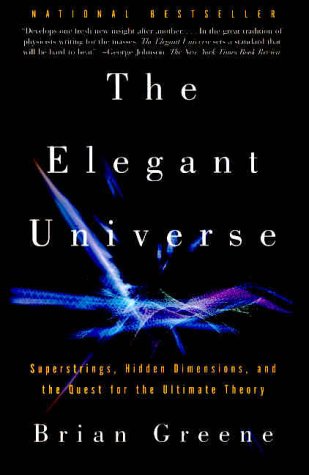
2. The Elegant Universe- Brian Greene
When you finish with Hawking, you may want to expand your knowledge to more current theories on string theory, M theory, or quantum tunneling. No one is better at this than Brian Greene. He is a string theorist, but try to not hold that against him. The beginning half of this book is wonderful. He uses real examples to teach us about dimensions, the speed of light and Einstein. I am not sure how much of the string theory stuff I buy into, but it is always good to see all of what is out there. He made a PBS special on this that you can watch online that is also great. I believe you can even use clips from it in your class. 

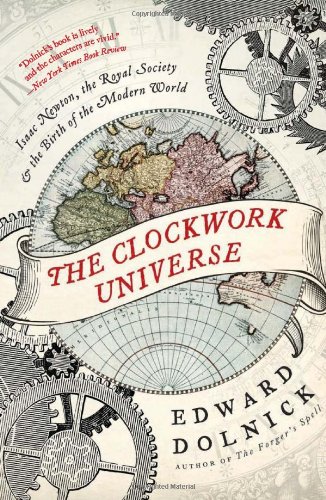
3. The Clockwork Universe- Edward Dolick

This is essentially a biography of Isaac Newton. I am a huge believer in the importance of the history of science. Scientific developments are subject to political pressure, society's whims, and funding. It was no different in the time of Newton, and it is no different now. I think you should definitely read a biography on Newton, Galileo, and Kepler if you are going to teach physics or astronomy. 

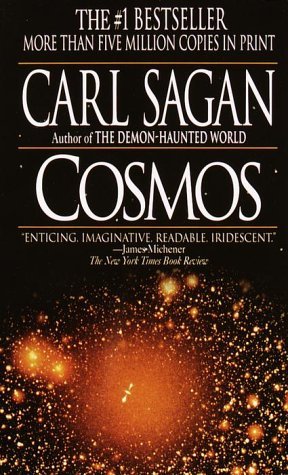
4. Cosmos- Carl Sagan
No one is better than Carl Sagan. He is somewhat of an icon in my astronomy classes. Even though this Cosmos series was shot in the 80's and has very poor effects as seen today, my students love it! Carl has a personality and a flare for drama that is unmatched in today's discovery channel specials. The series is on Netflix and is totally worth a look. This book is a must read for astronomy teachers. 

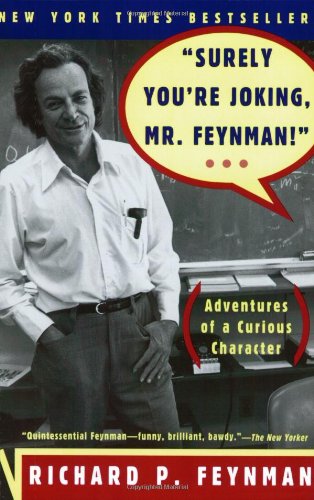
5. Surely You are Joking Mr. Feynman- Richard Feynman
Any book by Feynman is a gem. His books were ones that physics teachers anticipated like a 9th grade girl waited for a Twilight movie. He is funny, light, and brilliant. After you get a feel for Feynman with this one, check out his Lectures. 


FICTION
______________________________________________________________

1. Timeline- Michael Crichton
Anything by Mr. Crichton is great, but this one I really enjoyed. I am a big history buff as well. I heard at one time that the way in which he describes going back in time using quantum foam and such is theoretically possible, but you know how non-fiction is. This may be on my top 10 book list and has some interesting science in it. The movie is okay, but nothing compared to the book.

2. The Sum of All Fears- Tom Clancy
Tom Clancy writes terrorist handbooks. All of his books are amazing in their detailed descriptions of how the military functions. He describes the engineering behind a lot of military applications of what we talk about in our classes. His best book may be Rainbow Six, but this one describes how to create a nuclear bomb in intricate detail. Coming from the guy that crashed airplanes into the Capital Building a decade before Bin Laden, this guy knows the mind of the military and their enemies. I would suggest starting with Patriot Games and read the all. Ignore the movies. 

3. Science Fiction- Various Authors

I am going to cap this list off by encouraging you to read some science fiction. Although the science may be bad in these, the imagination that goes into the uses of simple scientific principles is noteworthy. I read these as they are classics that any fan of the genre are must reads. Most of these are a series of books that if you like the first one, you wont want to stop. 
  • Ender's Game- Orson Scott Card
  • Foudnation and I, Robot- Isaac Asimov
  • Battlefield Earth- L Ron Hubbard


Finally, as I have your attention, the best series I have ever read has nothing to do with science, but is amazing anyway. If you have not read George RR Martin's Song of Fire and Ice series, you are missing out. It begins with A Game of Thrones and only gets better after that. HBO has picked it up and done a great job adapting it to screen. 

Please let me know what you are reading as I am always looking for something new. 

Chris
@christopherlike