Showing posts with label professional development. Show all posts

Friday, September 19, 2014

10 Things High School Teachers Could Learn from Elementary Teachers

In my new position as our district's STEAM coordinator, I have had the opportunity to visit over 50 elementary classrooms in the last two weeks. Let me preface this by saying that I consider myself a highly trained and practiced physics teacher. I have dealt mainly with high school juniors and seniors for over fifteen years. The skills I have learned over the lat decade and a half have served me very well in working to prepare my students for the next step in their journey.

That being said...

I have learned more about teaching in the last two weeks than I had in the last 15 years! Please allow me to share some my new insights with my high school colleagues.

1) Energy is conserved!

I am convinced that the energy that a teacher brings to a lesson is transferred directly to their students. We can not create enthusiasm in our students, it has to come from somewhere, that somewhere is many times the teacher! Elementary teachers are some of the most energetic, wonderfully crazy people I have met. I could not believe the amount of effort they were putting into keeping their kids engaged. It was every minute of the day, and focused on every student.

I witnessed teachers dancing with kids when their reading character's danced. I heard them sing directions and content to their kids. I saw them use therapy dogs with special needs kids, hug crying girls who were asked to work with mean boys, talk to kids about farting, and run after kids at recess.

2) It's All About Moose Ears!

"Thumbs up if you understand the directions for the activity we are going to do.... Johnny, your thumb is not up, do you have a question?"  "Yeah, Mrs. Thompson, I want to know if it is okay to change crayons to another color." "That is a very great question, Johnny. I think you and your partner can decide that on your own... Okay 1A, Moose Ears if you understand the directions!"

We talk a lot about formative assessment at the high school. We talk about checking for understanding with our students before we move on, we have strategies that are employed sporadically when our students are really struggling. I think back to how many times we move on with our curriculum before the kids are ready. We have to get to three more problems before the end of the block... we have to kill Hitler by Christmas! Primary teachers do not move on unless EVERY ONE of their kids is ready and focused on the task. Procedure, procedure, procedure.

3) My Class Is The Best Class Ever!

Imagine my confusion when I walked into one of our elementary schools and heard a teacher tell her class that "3A is the best class ever" when just 5 minutes ago I walked out of 2B, which apparently held the title as well. Even spending a quick 15 minutes or so in each classroom, I came to realize that there were no less than 13 "best classes ever!"

Elementary teachers are blessed with the same group of kids for eight hours a day for an entire year. (I said blessed... you can substitute your own word if applicable). There is no fresh start with a new group of kids every 85 minutes, or even a brand new group every 9 weeks. They have to make the personalities in their room work together. There is no other option. They HAVE to know their kids like a family. High school teachers can get caught looking forward to 9:30 where this group of thugs will leave and be replaced by our nice, friendly second block. It is hard to develop a close relationship with 150 kids a year, so too often we don't see the value in it. Those kids will be gone in a bit, demoted to nods and an occasional fist bump when we see them in the hallway between classes. I am not saying that high school teachers don't develop great relationships with kids, they do. I challenge them to develop relationships with every kid, a necessity in our primary schools.

4) Differentiation is Possible

Imagine my surprise when I witnessed a teacher begin a math activity by asking her students to work through some problems in their notebooks. Then, without missing a beat, she pointed to three students and asked them to join her at her desk. I was taken aback. She just called out the kids who struggle in math in front of the entire class. In my mind I was thinking, what about their self-esteem? What will the other kids think of them being singled out? I looked at the rest of the class closely.... no one noticed a bit! The kids who were called forward actually looked excited to work with the teacher, and everyone else was a bit jealous. After about three minutes, Johnny was done with his work, so she gave him an activity from a book in the back that worked through some higher level math problems. She had three levels of skill working on the same concept at the same time and she did it flawlessly! Color me impressed.

5) You can still teach using a canned curriculum

I hate textbooks. As a high school teacher, I want the ability to develop  my curriculum to fit my teaching style and the learning styles of my students. I get really edgy when departments or states try to push a boxed package curriculum on a teacher. I think it stifles creativity and the ability for a teacher to tailor their lesson to the students in their class. Respect the craft is my rallying cry.

Elementary teachers make them work for them. This year, our district bought a new literacy and math curricula that comes in a lot of colorful packages. We have been using FOSS kits for the majority of our science lessons which literally has a slogan that brags about it having all you need to teach science in a nice closed box. Elementary teachers seem to enjoy having the planning of their lessons taken off their plate. They don't have time to develop lessons for all the subjects they have to teach. How can anyone create something new for literacy, math, science, social studies, and health in the 15 minutes of prep time they have while their kids are at recess? That is not to say that they can not and do not do a wonderful job being creative with the curriculum. They mold it and shape it to fit the needs they have that year.

I sat in three 3rd grade classes that were all reading about folk tales with the same story about a Hawaiian shark. Each teacher had their teachers guide in their lap and basically led the kids through the lesson. The teacher's edition told them what questions to ask, where to lead the discussion, and that this part of the lesson should take 12 minutes. What I found interesting was that each of the classrooms did the same exact lesson, but each room was different. Teachers had their content scripted, but not their reactions to it. They answered questions, put examples into students' own experiences, and made it their own. Having a position where I could compare identical lessons was intriguing.

6) Invest in good shoes!

I started wearing a pedometer on my wrist to see how much I actually walk in a day. After two weeks of data, I still have to reach my goal of 10,000 steps. I am pretty sure the primary teachers I saw would wear my wristband out. These teachers were buzzing around their desks at Mach 3 looking over shoulders, pointing to mistakes, giving high fives, fixing chairs, picking up books, and overall making damn sure their kids were on task. It was exhausting just watching them move so fast. It seemed to me that they wanted to check each and every student a couple of times a minute to keep them on task. Looking back, I don't even think they were doing it for my benefit! The students treated the whirling dervish behavior as par for the course.

7) There is a lot of thinking that goes into playing blocks!

I sat on a carpeted floor for 10 minutes and played blocks with a kindergartner named Max. He was explaining to me how he was putting together monsters with his blocks. You see, his monsters only came out at night, and Joe across the table was creating his heroes that only came out during the day. With snaps and fasteners, they gave their monsters and heroes eyes, ears, hands, blasters, and bodies. It was hard for me to see the picture they had in their head, but believe me, they had one. They carried on conversations about the creatures, correcting me when I mistook the red block to be the being's eyes when in fact it was it's butt.

Imagination is a powerful thing. Somewhere along the road to graduation, kids tend to lose this a bit. I don't know if it is due to social pressures, classroom assignment restrictions, or just a loss of wonder, but it is different at their level. Girls were playing house across the room. Another young man was drawing a picture of his dog catching a frisbee.

I just left our high school drawing 1 class where the instructor asked the students to bring in three objects for a still life drawing that told him something about themselves. He almost had to beg them to use their imagination to find things around the house that depict parts of their personality. He told me that without a doubt, the next day half the class will just bring in anything they find in the hallway, or their locker. Even when given the opportunity to improvise, our high school students are not comfortable with doing so. Many would rather not show that they can be creative, just get the job done and move on. How can we get them dreaming again?

8) Rewards can come in many forms

Remember behaviorism? Pavlov's dogs? I always found it hard to incorporate operant conditioning into a lesson that didn't involve grades. As high school teachers, we use grades as our reward and our punishment. Elementary doesn't have that luxury. They need to assess, then reward or restrict on a minute by minute basis to survive the day. I saw badges, line leader privileges, verbal praise, extra recesses, extra free reading time, fun video time, and about three hundred different ways to motivate kids. One kindergarten teacher took clothes pins off her lanyard with kids names on it and hung them from the ceiling fan because the kid was being "FANtastic" that day. Elementary teachers are masters of operant conditioning. I found myself wanting to be line leader or hoping that she would tell my table that we were being the quietest, nicest kids in class.  How often do we high school teachers formally or even informally congratulate a student on a test score? We talk to the kids who are struggling, but often find that the kids who do well don't need our extra attention. Actually they do! Teenagers strive for attention, often times acting out when they don't get it. Elementary teachers have behavior figured out.

9) When was the last time you saw this in your class?

 
Nuff Said!

10) Rinse and Repeat!

"Today is the 4th day of school. Can we count to 4?"  "Great! Lets see where 4 is on our calendar." "Can we get to 4 on our number line?" "How many pennies is 4 pennies?" "How do we write 4 cents? Can we write 4 cents in dollar form?"

If those kindergartners didn't know how to count to four after all of those examples, I can't imagine how 6 will treat them. This teacher repeated, sung, and danced the number four for over five minutes. She showed them so many examples of the number four in their lives, that the students were counting to four on fingers, toes, teeth, whatever! She wouldn't let it go, she wouldn't stop, and the kids learned.

We can't assume our kids get it the first time. Doing one example of a type of math problem is not sufficient to give our students mastery of a topic. They need practice, they need repetition. I worry about lessening homework in our middle and high schools. I worry about such a wide swath of content in a course that students become masters of none.


After I finished my parade of classes, I came back to our instructional leaders and talked about my amazing discoveries. I challenged them to pair up with a teacher at another level and visit their building. Next week I await their stories. What did they see in the elementary buildings? What insights will the former 4th grade teacher I am showing through the high school have? Will there be another post about what primary teachers can learn from secondary?

This document took me about 25 minutes to write. There was so much there to talk about, it was easy. I limited it to 10 because I am pretty sure you are bored by now. Please comment below with anything else that comes to your mind on the topic.

Thursday, April 24, 2014

Leaving the Classroom

I am leaving the classroom.

I am currently teaching my last set of students.

Today I am giving my Unit 2 Astronomy exam for the last time, tomorrow I will be introducing my Galaxy Fleet Gamification for the last time.

Dennis asked me for a pencil to take the test... that is probably not the last time.

It may sound as if I am leaving with a heavy heart and I can not deny that that is true. I will miss the kids, I will miss their stories, their worries, their struggles, the relationships I have not yet built. There is something special about having a classroom full of students to help guide through exciting times in their lives. I would not have gotten into this profession if I didn't believe in kids. I know I have made a difference in specific student's lives. They have told me and that is probably the most endearing compliment a teacher can get.

I am not asking for sympathy, I chose to leave.

My district was awarded a grant to develop a system for teacher leadership. I have accepted a position as our district's STEAM coordinator and I can't be more excited about the possibilities this holds. Unfortunately this position has pulled me completely out of the classroom, to which I regret, but the work ahead of me is both exciting and new.

I will be working with teachers, not directly with students. Can I develop the same kind of relationships with adults that I have had with kids? Probably not, but I plan on giving it the old college try!

What does a STEAM coordinator do? I am asking myself the same question. As this is a new position, I have the daunting and exciting task of defining the job. Having not worked a day in the position, it is hard for me to say what can be done, but I have some goals.


  1. I plan on coordinating curriculum K12 in all aspects of STEAM. Not only making sure that the levels (elementary, middle, and high) are sequenced, but set to standards and measured appropriately. I believe I will have a unique perspective in being able to see more cross-curricular connections between all aspects of STEAM. (I have some ideas about having our elementary gym teachers measuring times for runs and then kids calculating their speeds. Can you imagine that, doing math and science in gym class?)
  2. I plan on bringing the community into our schools. We have very strong community support for our school and I plan on capitalizing on that. Lets bring in some engineers to work with some of our classes or clubs. Lets get students networking with industry through internships and job shadowing. 
  3. I want to increase the participation and availability of STEAM activities after school. We have a strong commitment at the high school to our science club competitions. I would like to see that expanded to our other levels. We have a respected team at middle levels in lego robotics. How can I help bring that the to high school? What can we do at the elementary level?
  4. I plan on training our teachers in both content and pedagogy to help them meet the standards set by the district. Some of our elementary teachers are not comfortable teaching science. I plan on showing them that science is fun, engaging, and an avenue to teach reading, math, and thinking skills. Teachers at all levels need exposed to what is new in teaching methods. We have flipped classrooms, modelling, learning cycles, 1:1, and a myriad of other models to put in our teaching toolbox. I plan on giving them exposure to what works for them individually. 
  5. Technology at all levels is ever changing and teachers need to be brought up to speed on its best use. 
If there is one thing that I don't lack, it's ambition. (In my spare time I plan on curing cancer and working on world peace) These are the goals I have set for myself. They are lofty, but they are important. I can not accomplish these alone. I will need help from the great teachers around me, and you, whoever you are that took the time to read this. If you are a teacher, please share your thoughts on what you would like from a STEAM coordinator. If you are already in this position, please contact me and we can share ideas. 

It is an exciting time for my district and me personally. To accomplish these goals will take time, patience, and a lot of endurance. However I will have 8 hours a day, every day to work on this. When I look at all that I do in the classroom in terms of planning, grading, delivering, and collaborating on instruction, these 5 seem more than workable. Perhaps I will have to add a few more goals:)

Chris

Thursday, February 13, 2014

Educational Reform: Who Is Driving The Bus?

Buckle up, kids. This may be a long one.

As you know, I write when something sparks my interest. It has been a while since I put fingers to keys on this blog, but recently I have had the opportunity to discuss our chosen field with some differing interest groups. I can't spit without hitting a half dozen people who want to talk about education and what we are going to do to change our system. They find me at parties, after school, on email, twitter, or in the hallway.

And I love it!

What happens in our schools matters to everyone. In the short term, our individual students get the most benefit. They are the ones gaining knowledge, skills, and experiences that will shape their lives on a daily basis. We, the teachers, are also growing on a daily basis with the real experiences we are having with students, peers, administrators, and curriculum. Ultimately businesses are supposed to see benefits from these day to day happenings in a more viable work force. From this, our state and nation is supposed to see revenues from increased production and this a growing GDP.

We are all on a this bus riding towards our short term and long term goals. Who is behind the wheel? Who drives educational reform? I started brainstorming some candidates and the list got longer and longer. Everyone seems to know the best way to do things in a classroom.

1) The US Government:
This is probably the most publicized, as it doesn't matter where you live in the great USA, you can always complain about the government. But how much is "the man" bringing us down? It surprises me how hard it is for Washington to push real educational reform. They can tie incentives to dollars, but in reality most of a school's funding comes from the states. Probably the most controversial attempt at changing education came in the form of No Child Left Behind. In my educational circles, NCLB is treated like the kid who farts in church. We all know it is there, but if we feel that if we ignore and never bring it up to each other, it will eventually go away. Here is my take on NCLB. The only problem with the law is that teachers didn't think of it first! We took it for granted that we want every kid to succeed. The problem we have it that it came from politicians who negotiated it into nothing but a nuisance. I wonder, if given the premise of the law (which is a great goal) if teachers could do it right.

2) The Market

I read an interesting article the other day on how capitalism should drive our educational initiatives. It follows that if we are going to compete in a global economy, we are going to need a workforce that is prepared to work in it. After all, what is the world but a giant system of checks and balances, policies, and goods to be bartered. Our students, and we ourselves could be seen as just cogs in this wheel of consumerism and free capitalism. The market determines what type of workers it needs, what type of skill and knowledge they must have, and thus how we should teach. This is fine except for the fact that it is too slow. The market changes every day, people's lives change every year. It is almost impossible for us to train a fifth grader for what the global economy will need in fifteen years.

So we make projections, we look at data, and try to determine the best avenue. When you look at data for the economy, you are looking at aggregate data, with millions of data points, averages of consumer feedback and voter patterns. Some may say that even with all the statisticians we have looking at this data, it is never right. If it was true, and not subject to change, most of those morning talk-radio guys would be out of a job.

And how does this aggregate data compare to data taken in a classroom? Can I compare the 25 students sitting in front of me to the average across the nation? All of those factors that are brushed over with millions of data points are now staring me in the face. Fifteen of the kids come from single-parent homes, eight have learning disabilities, four can't afford breakfast, and one of them had a parent get arrested last night. Aggregate data means nothing to me when I have individuals in front of me.

3) Billionaires

Bill Gates is a humanitarian. There are a lot of billionaires who have cared about education and sought change. We appreciate the money, we appreciate the intentions, but many times we need to look at how much influence they are buying. It seems that a lot of the money from donors like the Walmart Waltons (see below) goes to special programs, charter schools, and reform institutes. All of this money is going outside our schools, to auxiliary programs that may or may not have our students' best interest in mind.

infographic showing nearly $6 million in Walton Family Foundation donations to StudentsFirst, Stand for Children, and Education Reform Now
http://www.dailykos.com/story/2012/05/20/1092800/-Billionaire-donors-drive-anti-teacher-pro-testing-education-reform-agenda

Donors who have money made that money by being successful in business, or a trade that paid them dividends. They make these donations as tax incentives to help in their businesses. I can't blame them, and really do thank them for being so generous as to choose education to invest their money. However they are still businessmen trying to make money. Their belief system, their values, and their expectations are still in place. They support their goals, or their beliefs. Does the Goldman Sachs Corporation have the same values as the kid in the back row of my class who spent twenty five minutes trying to secretly glue a girl to her chair?

4) Data

www.educationaldatamining.org

Getting a bit closer to home, I can tell you that if you want to see eyes roll in unison, mention data in a staff meeting. Businesses love data. Target can tell how many bottle of Listerine they sold next week in the last three years in order to extrapolate how many to order. They are very good at it. It is efficient, cheap, and technology driven. Things don't work like that in schools.

I am a scientist. I love data! If I believe in its validity, I can make some amazing predictions with it. However it is so easy to disregard any educational data as weak, varied, and invalid. It is very unlikely I can link how my kids did on a test to what I did in class. Sample size is probably the biggest factor. 25 kids is not enough to negate the variety of incoming levels, socio-economic class, or a multitude of other factors that could affect how they preformed on that Friday. Besides apples and oranges, I change so many aspects of my class each year it is impossible to see which change helped and which one hurt. Did they do better/worse this year because of the iPad initiative, the altering of some of the test questions, the fact that we had a speaker on Thursday, or the three snow days in the middle of the unit? Longitudinal data is impossible because I do change, and I should change things every year. I teach to kids, for kids. When the kids change, I change to accommodate.

5) Parents

I am somewhat in awe of the power parents have in a school district. If you want to talk about local control, here is the real deal. I can complain about my class size, the amount of materials needed for a science lab, or the need for a gifted program in my district until my eyes bleed, but once a parent speaks up, people listen. Get a couple of parents on board and you can damn near get a revolution in a school system. I think some would be surprised how a comment at a party to a school board member can lead to new math curriculum, or revamped band programs. Parents have a lot of power, and they should. It is their kids we are working with. They know their kids, they love their kids, and they want the best for them. However, parents are never unified. Never does a parent speak for an entire district. Parents are looking from the outside in, judging based on their past schooling experience. Does how they learned 30 years ago still apply today? If education is broken today, it was definitely broken back then. Also, not all parents had a good educational experience. Some still see teachers and administrators as "the man". So which parents do we listen too?

5) Administrators
http://www.frontpagemag.com/2013/dgreenfield/public-school-administration-grew-7x-faster-than-students-and-2x-faster-than-teachers/

This is my boss, so I had better play nice. I believe, and correct me if I am wrong, but teachers lose their "street cred" with other teachers once they leave the classroom. Some of the administrators I know were great teachers, worked very well with kids, and knew their stuff. They do a great job as facilitators of our school and at times can enact some good changes to our school culture. However, even being out of a classroom for a year, other teachers begin to feel that they lose the feeling of what it is like to face kids in desks. In a better world, admin would be free to visit classrooms on a daily basis to see what is going on, interact with all students, and be involved with classrooms. In a perfect world I think administrator should teach a section during the day. How would other staff view them, how would students view them if they were teacher-administrators? Sadly their job drowns them in discipline, meetings, money shuffling, and fires that they can't seem to ever get put out.

6) Colleges

Why am I doing all these projects, individualized learning outcomes, inquiry based labs, collaborative writing projects, and technological innovations in high school when in college they will be asked to sit in a 3 hour lecture hall with 650 other students listening to a woman read through a power point presentation? Too often universities hire researchers, not teachers. Nuff said.

7) Teachers
I bet you all are thinking I saved the answer for last. If you have read this far you can probably tell that I am very pro-teacher. Well I am, however if you think teachers can solve our problems you haven't ever been at a staff meeting.I have a lot of friends in the 'bizz' of education and I we rarely agree on anything! With so many initiatives thrown at us, we have had to pick and choose what we believe works and what doesn't. Most of the time the success of a class has very little to do with teaching methods, curriculum, or content. It comes down to one thing, and one thing only. The relationship the teacher has to the student! You can't quantify that, you can't teach it, you can't test it, but it is real. Teachers can't change the world alone. We don't have time, resources, or enough left in us after a day in class to do the things that need to be done. What we do is personal, it's individual, it's full of motivation, compassion, and care. We may not be able to change the world, so we just change one kid at a time.


Bonus Answer: Students!!??

There is a big push for student-led investigations. These can be very good, in small doses. I can't believe that we can run a curriculum on just what the students are interested in. If that was the case, I would have never learned to read. My kindergarten world revolved around which girl to chase at recess, not how how well Dick and Jane could jump and bike. My parents and teachers knew what I needed to be a well rounded adult and I trusted them to sculpt me. There were times when they failed, but overall I am sure that if I had more of a say in what and how I learned, I would not have interests in a tenth of what I am interested in today.

So what is the answer? EVERYONE and thus NO ONE! We all have our interests, but there is no one out in the forefront of this thing. We do our best with a system that is based on money, politics, and historical tradition. What should drive our change?

Just my ramblings. Take them as you will but feel free to comment before. Please add to my list as I know it is not comprehensive.

Chris
@christopherlike

Friday, October 18, 2013

#Iaedchat on Gamification


#iaedchat Gamification in Education

(Note to self: make a better face when starting your video if you are going publish it for others to see)


The following are links to pages on this blog if you are interested in developing your own game. If you have intentions of going down this path, please hit me on twitter or email. I am more than willing to consult with districts on their games. I have worked with several districts who have begun to develop their own games.

Gamification Intro

Mission Possible: Our Professional Development Game


Mission Possible Overview

Crowdsourcing Your Professional Development

The Back End of Mission Possible

Mission Possible: Behind the Curtain (Video)

Link to our Mission Possible Site

Galaxy Fleet- Gamifying a classroom

Gamification with Students: Galaxy Fleet

Galaxy Fleet 

Galaxy Fleet T-1 day.. This then goes on for several posts dealing with how the model worked in the classroom.


Please let me know if there is anything I can do to help. Good luck!

Chris
@christopherlike

Thursday, September 19, 2013

Today's Fix for Education!

So yesterday I was sitting through a meeting of the Governor's Task Force on the adoption of the Next Generation Science Standards. We spent the day being brought up to speed on the current Iowa Core Science Standards... their inception, intention, and development. I listened for many hours to the reasons that the standards were made, continued to refine my opinions of the feasibility of the standards, and their merit with respect to the NGSS. 

It was during a panel discussion with some of the writers of the standards that something occurred to me. It was a simple idea, common sense really, but so foreign to today's thinking that it was almost incomprehensible. 

The panel was discussing the elementary standards (something I am fairly well versed in even though I teach high school). They mentioned that they banded them to grade bands, and made them a progression, but limited in content due to the fact that elementary teachers have so many other things to worry about on top of science. For a moment I thoughtfully placed myself in the shoes of one of these elementary teachers. These are a group of people who work very hard with challenging kids, teaching them to read, add, think, spell, write, and grow into young adults. They are being pulled in so many ways that if I were them, there would be no way I would be able to keep anything straight, let along try to adopt new standards every few years. 

THE FIX: 
Why do we have separate standards in elementary for literacy, math, science, social studies, and all the others. Why don't we just have one set of standards that encompass all of these. For middle school and high school it makes sense to break standards into disciplines because we teach specific content areas. Why do we throw all of these different documents at our elementary teachers when they only have like 15 minutes of prep at a time. I believe that learning could be much more integrated in the younger levels if someone took the time to COMPLETELY ALIGN their standards. My son came home with a math problem the other day where he was supposed to read a histogram of kid's heights in a mystical class from his math book. Why could he have not done an experiment to take that data himself, plotted it, and tried to draw conclusions about age and height? I will tell you why... that is science and he was learning math!

I am not saying that teachers do not try to integrate this as much as they can; I think they do. I just think that if we write the documents for the standards in one form, they will not tend to split them off. I would hate to try to master all of those documents. Why not just have one?

Maybe I am completely out of my area here, but I think it is possible. I realize that different committees made each of the common core standards for each discipline, but why can't they talk to each other? Make the standards seamless, easy to use, and adaptable. Then let teachers find creative ways to meet them.

What do you think? I am off here?

Chris
@christopherlike

Sunday, September 8, 2013

Mission Possible 2.0

I recently published an article in Learning and Leading with Technology outlining my work on Mission Possible. Let me tell you that my emailbox/twitter/blogger has been full ever since. I can not thank all of you enough for your support of my model, or express the delight I have in hearing all of the innovations that have come from this simple linking of ideas.

If you follow this blog, you will probably noticed that I have not posted much in a long time. Right now, I am in the middle of golf season, trying to teach an overfull schedule including biology (not my fave), and keep up with the enthusiasm surrounding the globalization of Mission Possible.

With that, I am always willing to help all of you in any way I can. With the volume of requests I am getting it is making it hard for me to put in the effort I believe you need from me in beginning this process. When confronted with this kind of problem, I face it down like a heavyweight.

I have decided to kick the help I offer up a notch. If you are serious about starting a game, I believe whole-heartedly that I have experience to offer. I am willing to work with you virtually, as I have been, but truly believe that I could do more help working with your people face to face. I have been approached, and am willing to work as a consultant on beginning this process. If you have a small amount of funds to get me there, I can find time to work with your people; be it teachers, tech staff, or administration. As you all know, I am giving my model, my files, and my ideas away for free. I will never charge you to use the idea, but I do want you to succeed and think I can help.

As for Mission Possible 2.0, I have some new items on my agenda.


  1.  I am working with some programmers to make the back end files more self-serving, using advanced formulas and trying to get the points to add up easier.
  2. I am also working with programmers to try to find a way to upscale the model for larger districts. I am looking at Microsoft Access for the database, infused with google sites or wordpress.
  3. I am beginning to implement "Achievements" as a new reward system in the game
  4. I am looking at the upper levels and expanding them to include more choices for teachers. 
  5. I am finding new ways to reward teachers for their accomplishments. 
  6. I am working on trying to incorporate social media as a more integral part of the game.
If you follow our site, you will see some of these changes as they are being made. This kind of thing is never finished, it is only made better. If you would like to discuss my ideas, please respond here as always, hit me on twitter, or chuck me an email. 

Cheers,

Chris
@christopherlike
christopher.like@gmail.com


Friday, August 23, 2013

(Video:) Mission Possible- Behind the Curtain

I know it has been a while since I have contributed anything to this blog, but I thought it was time. I recently was fortunate enough to get an article published in Learning & Leading with Technology. Since then, I have gotten several emails and calls about how I run the back end of the program and thought it may be nice to put my thoughts to Youtube and try to answer any questions that come up.

When I did this, it was using free software and knowing very little programming language. If anyone who knows more about computer programming than me (which is probably all of you) and wants to help out on this project, I would love to find a way to better keep track of these totals.

That being said, here is a quick and dirty run through my model.


If you have any questions, or would like me to go further into any part of the model, please let me know and I will try another screen-cast. I have also meet several times on Google hangouts or Skype with interested parties.


Chris

@christopherlike

Thursday, April 25, 2013

Galaxy Fleet Gamification Day 1 recap

Well I survived the first day of my classroom gamification experiment. This may have been the most important day of the lesson, the day I had to sell the students on the idea. Here are a couple of observations from that first day that I think I should share.

  1. I did not bring out the coat to turn myself into the hard ass admiral as I planned. I ran the class as myself, but as we got into the game I did joke about how I was thinking of using the character. They thought the yelling and the southern accent was pretty funny. I will pull him out when the class needs some motivation (in a tongue-in-cheek kind of way)
  2. Overall they seemed to think of this as a pretty good idea. It is hard to get a read on every student in the room, but most expressed willingness to try it. 
  3. I heard comments from some of the best students in class that they were going to be the first one to the level of Captain. For the top end student, it took me literally four minutes to tap into their competitive nature. Lets see if it will hold for the entire unit.
  4. The mid-level students seemed to like the idea in general (most are "gamers" and the idea of gamification seemed natural to them). I think they are a bit hesitant about the amount of work that I am going to ask them to do, and the testing involved, but hopefully they will fall in line as we go. 
  5. I have a group of lower-level students that concern me the most. There are two sects here. There is a group of four that sit in the back, do little work, and thus do poorly on exams. I know for a fact that these are smart kids, who have the ability to learn this. However, they are disenfranchised with high school in general and thus are the hardest to motivate. I have been working with one of these individuals a bit lately, talking to him about being a leader of his group of friends, and how he can help focus their attention. I am happy to say that out of all of the students in the class, he was the most excited about the game on that first day. I think he wants to do well, but for some reason that is not "cool" with his friends. This is giving him an avenue outside the normal school-type functioning, that he can embrace. I will work on him a lot through this experiment. 
  6. The other sect that worries me are the students who feel that they are not smart enough to do the astronomy. They feel that their background, especially in math, is hindering their learning. It is my hope that both of these groups of low-level students can feel some successes in the lesson as they go and that that success will carry them to learn the material. 
  7. I will say that the game is also fun for me. Having created a "Star Trek-like" game, I made myself the commander. I asked them to call me "Sir" or "Admiral". That is fun in itself. They stand at attention when I enter the room, which really is a cool feeling. 
Yesterday we did an intro to EM radiation with the activity Lost in Space. Today we will be exploring the EM Spectrum and beginning an activity on the Inverse Square Law. 

I will let you know how it goes.

Chris 
@christopherlike

Wednesday, April 24, 2013

Galaxy Fleet Day 1

Today is the first day of my gamification experiment and I am excited to get it started. The anticipation of something new can be consuming, and filled with anxiety. You all know how it is. I was up this morning at 4:30 with epiphanies about creating characters for the class. Do I think the kids would like to meet a hard-ass military general who will introduce the game to them? Do I put on a coat and accent my voice to turn into  this character or just do it as myself? Cool or lame... it is a fine line. Science Expert Dr. Like in a lab coat could take them through the activities... ???

I brought the coat but even one hour before class starts, don't know if it will come out of the closet. Game-time decision.

I did figure out how I am going to grade this thing though. My plan is to have 85 points for each learning cycle. 30 points will be from their scores on two of the three bar exams, 45 points will be from the activities that gave them the commendations the exchanged for the exams, and 10 points will be if they participate in the process. I don't like participation points, but with what I may ask them to do, it would be nice to give them some small reward as an incentive. I am thinking of taking off those points if say, they don't follow the game by wearing their lanyard displaying their rank or stand at attention when the General enters the room, or call me sir... you know the fun part of the game. With three learning cycles planned, that is relatively the same points I would have devoted to this last semester.

Time is a big factor in this, so I will be pushing them hard. It doesn't help that I just graded their last exam and it was far from stellar. I plan on using this fact as a springboard for changing what we are currently doing to something new, fun, engaging.

Wish me luck. I will update you all tomorrow on how it went.

Chris
@christopherlike

Wednesday, April 17, 2013

If Twitter is the Answer, What is the Question?

I recently heard George Couros (@gcouros) speak to our K12 staff about advances how our society utilizes technology and how our schools need to catch up. I have to say that I agreed with most everything he said. I am obviously a blogger, believe that we need to foster 21st century skills in our kids so they can compete in a global economy, and firmly believe in giving back to my profession. Last year as the keynote speaker at our National Honor Society induction I urged the students to create something (ala #Starwarsboy). Needless to say on most respects Mr. Couros and I seem to be cut from the same cloth.

That being said, I want to address a twitter issue. I call it a twitter issue because it is becoming an epidemic in teacher circles. So much so that the teachers that probably need the good attributes of the media platform want nothing to do with it. Mr. Couros stated that "If you are not on Twitter, you are becoming illiterate." Many of those I follow on twitter are engrossed in the wonderful things that twitter can offer. They have encouraged its use by others to a point that it is starting to have a backlash around the water cooler. I am not being critical as I do use it in edchats, have connected with some great educators, and have gained some followers that are probably reading this right now because of it. I think twitter can be a good thing. It has been a good thing for my professional development.

Twitter doesn't address the real problem though. The problem, as I see it, is that many teachers do not feel a need to better themselves using any method. There are many reasons. Time is the biggest. With grading papers, planning for the next day, calling parents, running a class, meetings, and initiatives it is hard to find time to devote to your learning. Some have done very well in the profession and feel they can ride out the rest of the ride, and some think they knew it all coming out of college.

Many of us do see the need to keep up. Before blogs, twitter, news feeds, and online publications, used to get peer reviewed journals in the snail mail. We know that education changes and that attending a conference once a year is not enough to know your profession. We wrote (and still write) articles to educational journals, do research in our classrooms, and share back to the profession. When I started, I knew very few in my building that did this kind of activity. This kind of intrinsic professional development was the realm of college professors, AEAs, and department of ed committees.

What we need to recognize is that that has changed. Giving back to the profession should be a regular part of the job. I write this blog as a way to do that. I recognize the importance of giving back to the profession and that is how we as a nation will get better. I feel like I am being a teacher in writing this and I make time even though it is precious.

Yes, twitter is an avenue to do this, a good avenue really. I use it regularly and I believe that. But it is not the only avenue. Mr. Couros's quote is not unique. Many more like it sail around the ether of RT-land spreading like the flu. What those kind of quotes do is divide our profession into followers and dissenters.

If we want real change in our teachers I feel we need to encourage them to grow using the exploration of whatever kind of media a person feels comfortable with. Zite, Flipboard, Google Reader, News Sites, the Dept of Ed Website, or online publications can do this in some ways better than twitter. I have been encouraging those around me to read these kind of things, to keep themselves current to what is going on, and to join in on the conversation. I have seen in the last decade, even in the last year, how much more accepting teachers are of new ways of learning for them and their students. I know we have a long way to go, but when I find myself reading blogs on educational policy instead of watching Netflix, it amazes me how far I have come. I look at all of the social media and news sources I read in a day and still realize that most of my opinions are made by talking to real people, face to face. We discuss issues, we probe problems, and refine our thinking in real time.

I worry about relationships in social media. We are not walking through this technological adolescence, we are running blindly. I dig you guys, I really do. I enjoy having followers on twitter and hearing from people who read this blog. I have no problem carrying on a dialog involving education, but I, and you have to know that that is not a conversation. It is not a conversation when you can script what you are going to say, edit and delete before you hit send. It is not a conversation when you are limited to 144 characters. I worry about our kids and how this will effect their relationships. Relationship dynamics are changing and I don't think anyone knows how that will effect us and our students. We can't forget those around us for those a half a continent away.

That being said, I am going to stop there and read a book with my daughter.

Chris
@christopherlike

Saturday, March 23, 2013

Smart students begin with smart teachers.

It began with nazis. Fermi split an atom, Hitler captured France, and the best nation in the world freaked out.

It continued with Sputnik. The Russians beat us to space, put the first dog in space, and then there was that Yuri guy that only us science teachers remember.

What followed both of these events were national demands on learning science.

In the 40s, universities were raided for their best graduates, drafting then into the manhattan project, putting them in secret towns in New Mexico where the brightest scientists in the country could collaborate and learn from each other.

In the 60s, it was a race to build the best rockets. We took enough shots to the chin, that in a comeback move only rivaled by Rocky Balboa, we strapped on our big boy boots and planted them firmly them on the moon.

If the driving force behind this push was national pride, the vehicle was education. We needed the best and brightest in the world, here making these discoveries. We valued education because it was the means for reaching our goals.

My high school physics teacher was a product of this time. He brought expertise and experience to the small village of Monticello, encouraging the 92 kids who graduated in my class to think, reason, and problem solve. His masters degree was in physics, earned through programs left over from the Sputnik scare. In the 70s and early 80s, there was still this belief that teachers should know science. All this went away in the 80s. We became more concerned with self image in our students, nurturing their thoughts of self worth instead of scientific principles.

Today, it is almost impossible to get an advanced degree in science, unless you count it's slow cousin "science teaching." My masters degree is in instructional design and telecommunications. It was close, cheap, and offered its classes on the weekends and at night. Unless I wanted to take a year off, there was no degree at any university within a hundred miles of me that offered classes in the summer time. Summer time is when professors did a majority of their research, brushing off those annoying classes they have to teach between publishing papers.

This is a problem, and I am positive it is not just a science thing. Teachers want degrees that matter, they want something that will help them be the best at what they do. Unless you want to be an administrator, the pickings are slim for grad programs.

NASA is cutting all their educational programming! I know! If you don't believe me, read this posting (http://scienceblogs.com/startswithabang/2013/03/22/the-end-of-nasas-education-and-public-outreach/).

What does this day about where our nation puts its priorities? Perhaps making fuel efficient cars is not as sexy as going to the moon, or blowing up Japanese cities, but I can argue that it is more important. We hear our leaders preaching about STEM, but when push comes to shove, do they support it? We spend millions put technology into our kids hands but don't train teachers in its appropriate use. You can't buy an education with trinkets, it has to be earned. The first step in supporting our students is supporting our teachers.

I am a firm believer that teaching is 30% content knowledge, 20% pedagogy, 20% an art form, and 30% grit and determination. (Somewhere in there I should include politics, paperwork, and vodka)

Chris
@christopherlike

Monday, March 18, 2013

The Back End of Gamification in our 1:1 Professional Development

I have posted several previous blogs on my model for gamification in our professional development. If you are interested in how the idea was started, read "Gamification in Education: It's World of Warcraft without the Warcraft." or "Mission Possible: Playing Games with Professional Development." If you are interested in how I incorporated crowdsourcing into the game, read "Crowdsourcing your 1:1 Professional Development." If you are interested in how I keep track of the points on the back end of the system, continue reading on:)

I will begin by saying that this is by no means the best way to do this. I am not a programmer, I am a physics teacher. My programming skills are completely self-taught and consist of some flash action scripting, enough html to be dangerous, and enough C++ to know that semi-colons are very important. I was talking to my nephew yesterday. He is a computer science major at the University of Iowa. I may have talked him into trying to develop the data analysis of this game for a class project he is doing for his degree. In fact, when Des Moines came to me and asked to see my programming mojo, I told them to hire someone smarter than me to build them an app.

That being said, here is a peak behind the curtain.

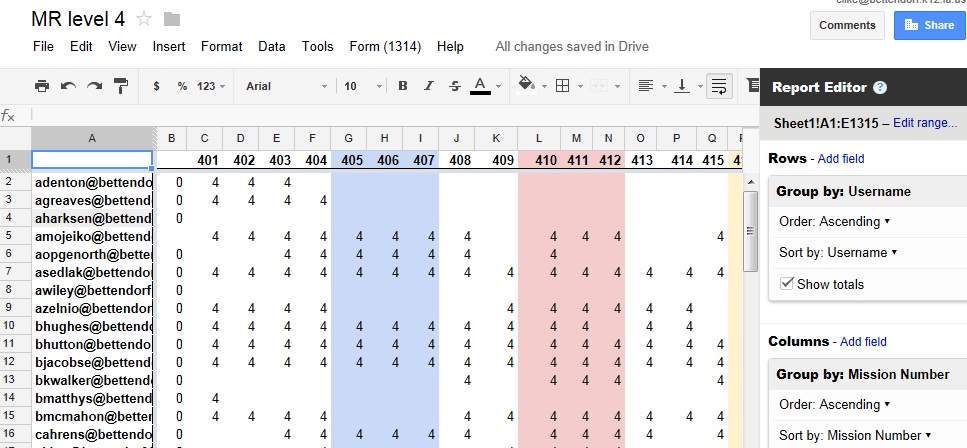
When teachers do a mission, they are to receive points depending upon which level the mission falls under. 4th level missions are worth 4 points, etc. I have to record that they did the mission, assign them the points, and then add up their total points. I do it all in google docs for the simple reason that I am comfortable with spreadsheets, and it's free. Here is how it is done. At the end of every mission, teachers submit a google survey to rate the mission's effectiveness. They have to put their mission number, and the survey records their user name.
This data then goes into a spreadsheet for that level. All 4th level missions have the same form on them. 5th level missions have an identical form that feeds into the 5th level point totals. I then create a column on that sheet that truncates the mission number to the first number. Thus mission 403 will be truncated to 4. This is where the mission number turns into the points awarded. 


I then create a pivot table that accesses this information with the teacher's username, mission number, and returns the points awarded. The final column on the pivot table adds the total number of points for that level. The different colors on the table allow us to keep track of chain missions. If someone does all in a chain, they earn a new title. 
The third worksheet on this document is where the totals are linked to the teacher's actual names. Basically, we have a list of names associated with the users, and an equation copies the total column from the pivot table to this "totals" spreadsheet. The equation used is a VLOOKUP, that looks up their username, and returns their total. 

Now that I have their real name associated with their point totals from that level, I simply copy each of the point totals to a different "Leaderboard" spreadsheet. It has columns for each level, and adds the numbers in the end. The actual leaderboard simply references that sheet and is displayed for the staff. 

Easy peasy.

Let me know if there are any questions. If I get ambitious I may do a video tutorial on how this is done to show you around myself. 

Chris
@christopherlike


Thursday, March 7, 2013

Crowdsourcing Your 1:1 Professional Development

In an earlier post, I talked about a professional development model that I created for my district based on gamification. We call it Mission Possible, a game-like system where teachers work through "missions" in order to gain achievements to reach higher levels of tech greatness. Read more here! I kind of left you hanging with the second part of the PD that I feel makes it successful.

Crowdsourcing is a big part of the model that individualizes the PD to departments and even specific teachers. I am not sure how Webster defines crowdsourcing, but I can give some pretty good examples.

Astronomers, in an effort to map the sky have taken pictures of millions of galaxies with telescopes like Hubble, or the Keck Telescope in Hawaii. The next step in their experiment was to categorize these galaxies as spiral, elliptical, irregular or peculiar using Hubble's Galaxy Classification system. Basically you would need to look at these pictures, determine if there were spiral arms, or other things happening that would put the galaxy into a certain category. As it turns out humans are much better, even after simple instruction, than computers at doing this. Astronomers had a problem. With the six grad students working on the experiment, they could not look at the MILLIONS of galaxies. They created Galaxy Zoo. This website gives anyone a brief intro to how to classify galaxies, then shows them pics and has them practice. Using some simple questions, they use people around the world to classify actual scientific data. Within 24 hours they were getting 70,000 classifications per hour, using over 150,000 people in the first year.

With Mission Possible, I wanted to have missions that were specific to disciplines around the school. I am not an expert in Foreign Language, so I go to the experts. They can progress in the game by earning points creating missions for others. As part of the game, a teacher creates their own tutorial, shares it with others, and contributes to the actual making of the game.

I believe that this ownership of the game itself is a big part of the buy-in we get from our teachers. It is not a game where I or some Tech God who know everything is telling them what is important to learn in tech. No one knows every application of tech in our school. There are pockets of experts that I am tapping into with the crowdsourcing missions. Teachers realize that the game is theirs to play, and create as they go. The tutorials are there for other's use, which gives the teachers recognition and a part of the satisfaction that I feel in the success of the game.

I know there are a lot of you looking to adapt this model in your own systems. Do not forget the crowdsourcing piece as it will help you with manpower as well as buy-in. Good luck and let me know how it goes.

Chris
@christopherlike

Thursday, February 28, 2013

Concentrating on Concentration

If you have been reading this blog, you probably have picked up on the fact that I am not one for gimmicks, new buzzwords, or educationese that has little basis in research. That being said, I want to talk about something I came across in college that I truly believe changed my perspective on being a student and life in general. Sounds like a big deal. Here is how it works.

David Ellis wrote a book called "Becoming a Master Student." I was introduced to Mr. Ellis's work when hired as a mentor at UNI in the student services department. His ability to pin a catchphrase to life's challenges is so cheesy that it is memorable. The surprising thing to me is that it works!

Be Here Now!

 The crown jewel of catch-phrases, this one has stuck with me for the 15 years it has been since college. Here is the basis of it. Have you ever met someone, they gave you their name, you shook hands, gave them your name but then had no idea what their name was? I do it all the time! Mr. Ellis contends, and I agree, that you weren't there at the moment they said their name. You were thinking about your name.

This deals with that little voice in your head, that little guy or gal who is constantly talking to you. If you are quiet, you can hear it. Try it... Yours may have said "this is dumb," or "I'm hungry", or "What little voice?" THAT'S THE VOICE! It is annoyingly off task most of the time. Ellis quotes that some researchers say that you can not keep that voice on task without consciously doing it for more than three seconds. It takes practice corralling that little voice.

Pay attention to your attention!

What is better than that catchphrase? You need to know that that voice is going to be off task and you need to put it back on track. Pulling your attention back to attention takes practice. Athletes do this. When Tiger Woods stands over a put, his focus is solely on what he is doing. He is "in the zone". This is a hard thing to do. While walking down the fairway, golfers learn to let their mind relax, think about something else, and let their little voice wander. Then they bring it back in focus when they get to the ball.

Do what you are doing while you are doing it!

This Ellis guy is a master wordsmith if there ever was one! Bring your attention to attention (God, I am doing it now) when you need it. For students you can talk to them about daydreaming. It is okay to give yourself a bit of a rest while listening to a lecture, but do it at an appropriate time. Know the consequences of taking a few seconds or minutes to tune out. Can you anticipate where the lecture is going? Is this something that is essential to understanding future topics? What will it mean if I do give my concentration a break?

This paying attention to your attention (it's hard to stop when you get going) has amazing results. By going over these simple principles, giving students an appreciation for how their brain works, can really improve their school experience. For teachers, this will make you a better listener, which is great for the classroom, relationships, and just about every aspect of life. Try it, remember the catch-phrases. If you want more on this, get Dave Ellis's book and dive deep. (I am in no way affiliated with Mr. Ellis and neither he nor anyone in his employ are paying me to say these things:)

As always, your comments are encouraged.

Chris
@christopherlike

Wednesday, February 20, 2013

Mission Possible: Playing Games with Professional Development

A few posts ago, I talked a bit about Gamification in education. I then went on to discuss an idea I had to apply this to my classroom with Galaxy Fleet. After presenting at last weekend's Iowa Edcamp, I am inclined to give you some specifics of the Professional Development model I created that uses these principles.

Mission Possible is our district's model for professional development with regards to technology in our 1:1. In creating this process, I was looking for something that was highly engaging (or as engaging as any PD can me) as well as individualized and fun. Teachers were coming into our 1:1 initiative at many levels. We had those who could not wait to get their hands on their iPads, and those that never planned to take them out of the box. I needed a system that would challenge the high flyers while bringing those indifferent to the technology into the fold.

I see learning technology to be three fold. First there has to be a time where you simply get comfortable using the device or programs. In the game, this is where teachers begin. Level 1 teachers are given the title "Noob", a distinction that they no doubt want to shed as soon as humanly possible. Upon reaching level 3 in the game, they are considered "Users". I see users as teachers who are not afraid to turn on a computer or device and use it, but may not know exactly what to do with it. They want to play with different apps, find already developed programs to use, and master them. User levels (3-6) are where most of our teachers currently sit after about a year into the program. Upon reaching level 7, we start referring to teachers as "Tech Geeks". These people are comfortable finding apps and using them. They don't need any more in-service on what is out there or how to find it. Their levels shift to how they are going to implement these strategies into their classes. They collaborate with other Tech Geeks to infuse the technology or they share their expertise with others by leading sessions on in-service days.

Those are the three Tiers of the game. The mechanics follow real basic gamification principles. To gain a level, teachers do "Missions." Missions are set to take about 15 minutes each. A level 1 mission earns the teacher 1 "Paw Point" (we are the bulldogs). Once they reach 10 paw points, they lose the noob status and become a level 2 novice, on their way to being a User. Level 2 missions are worth 2 paw points each, level 3 worth 3 and so on. Teachers are not allowed to do missions above their level, but can "farm" lower level missions for small amounts of paw points.

Here is the website for the Game. 

You will not be able to see the leaderboard, which we do post so everyone knows where they stand. At the onset of the game I made a couple of things very clear with both the teachers and the administration. First, this is NON-EVALUATIVE. At no time will an administrator come to them and ask why they are only 5th level. I am a firm believer you get from Professional Development what you put into it. The only requirement that teachers have in the game is that whenever they are given time to do missions, that they put forth their best effort. Second, the game is really on the honor system. No one is going to be standing over their shoulder watching them do missions. Again, you get out what you put in.

I can tell you that this posting of the leaderboard is a key to the game aspect of it. It engages teachers' competitive nature just like Call of Duty does with my eldest son. The guy at the top will not let others ahead of him, even though they try. Some don't want to be at the top, but they always want to be ahead of that person right above them. The level of interest has dwarfed my expectations.

As teachers move through the game they can pick up other titles along the way for completing sets or "chains" of missions. If a teacher does a set of 5 missions on twitter, we give them the title "Twenius" on the leaderboard. This allows others to see who are experts on programs they might be interested in. They can seek them out instead of the tech department.

I encourage you to develop your own game based on this model. I am not selling the idea, I am giving it. Use it, make it yours. In doing so, I can give some advice. Keep it light; keep it fun. Name the missions with cute names like "Mickey Mouse is Pissed" for copy write, or "How do I put my face on Jennifer Lopez's body" for paint programs. Put effort into selling it to admin before the teachers. Time is always the biggest issue. Some teachers will do missions at night while sitting in bed, but most will only have time to do them when given it by admin. Be sure you have their support before selling it to the teachers. Celebrate successes. We always tweet out when someone raises a level. We have given prizes like earbuds to everyone who hits 5th level, or stylus's to the first 5 who hit 7th level.

Crowdsource the making of the missions to your teachers. Upon reaching level 7, teachers are beginning to help in making the actual missions, or ratifying earlier missions to make them better. I do not have the time or expertise to make missions for apps in all the different disciplines in my school. I let others do the work for me. I can post more on this later, but it is a big part of what makes Mission Possible actually possible.

As for the back end to this, I did it in Google forms and spreadsheets. Why? They were free and I kind of knew how to use them. If a programmer reads this and wants to write a database that keeps better track of these things, please do and share it with me. If you are interested in seeing the data side of this, please let me know and I can post something on that later.

That is an overall look at the game. I have presented this at a couple of conferences and can tell you that the idea is spreading like the clap at Woodstock. Grant Wood AEA is trying to develop something, I have had talks with the Des Moines School District, as well as Dubuque AEA and several smaller districts.

Let me know if there is any way I can help in these or other endeavors with this idea.

Chris
@christopherlike

Monday, February 4, 2013

Gamification in Education: It's World of Warcraft without the Warcraft.

...Well maybe with a little warcraft depending upon how you roll.

I first came upon the idea of Gamification from my brother, an IT guy working in the business world. I was telling him that my district was asking me to develop the professional development for our 1:1 initiative. I told him that I was looking for something new and innovative, something that will engage the teachers in my high school that was ongoing and individualized to teachers' needs. He mentioned this idea that had been around in the business world for decades: Gamification.

Gamification is the idea of using game dynamics in non-game scenarios. Basically it works like this. Video games and role playing games outline overall goals that they want you to achieve. They then design specific tasks that you do in order to work your way towards these goals. (Sounds a lot like my classroom) I have witnessed my son playing for hours on the computer, fighting bad guys on the game DC Universe. If you ask him what he is doing, he will tell you that he has to defeat enough Joker goons to gain experience to gain a level. What is at that next level? More Joker goons! Seems odd, but if I could engage my teachers (or students) at 1/10 of his level, I am doing great things.

Gamification has existed in business for decades. Karate has its belts. You perform a set of tasks and you are rewarded with a darker pigment around your waist. Airlines have frequent flyer miles, Discover card has cash back, and I can't turn the TV on without hearing about some reward my wireless company is giving out. These are all aspects of gamification.

Long story short, I devised a professional development for our staff based on this and other important principles. I am going to save this for a later post. We called it Mission Possible and it is working very well. I have presented it at a couple of conferences where it has been very well received and even have an article being edited for publication in Tech and Learning. More on this later.

At one of my conferences, I was asked if I had ever tried this with students. As I had spent so much time working on the PD, I had not yet developed anything for kids. I know there is a guy at Classrealm who has been developing some stuff, but I had not worked on it for myself. Bouncing ideas off another teacher in my building, I began to work on something special. I am pretty excited about it, but since it is a complete new look at managing my classroom, it is a little scary.

I will outline what I have for you tomorrow.

Chris