Showing posts with label gamification. Show all posts

Friday, October 18, 2013

#Iaedchat on Gamification


#iaedchat Gamification in Education

(Note to self: make a better face when starting your video if you are going publish it for others to see)


The following are links to pages on this blog if you are interested in developing your own game. If you have intentions of going down this path, please hit me on twitter or email. I am more than willing to consult with districts on their games. I have worked with several districts who have begun to develop their own games.

Gamification Intro

Mission Possible: Our Professional Development Game


Mission Possible Overview

Crowdsourcing Your Professional Development

The Back End of Mission Possible

Mission Possible: Behind the Curtain (Video)

Link to our Mission Possible Site

Galaxy Fleet- Gamifying a classroom

Gamification with Students: Galaxy Fleet

Galaxy Fleet 

Galaxy Fleet T-1 day.. This then goes on for several posts dealing with how the model worked in the classroom.


Please let me know if there is anything I can do to help. Good luck!

Chris
@christopherlike

Sunday, September 8, 2013

Mission Possible 2.0

I recently published an article in Learning and Leading with Technology outlining my work on Mission Possible. Let me tell you that my emailbox/twitter/blogger has been full ever since. I can not thank all of you enough for your support of my model, or express the delight I have in hearing all of the innovations that have come from this simple linking of ideas.

If you follow this blog, you will probably noticed that I have not posted much in a long time. Right now, I am in the middle of golf season, trying to teach an overfull schedule including biology (not my fave), and keep up with the enthusiasm surrounding the globalization of Mission Possible.

With that, I am always willing to help all of you in any way I can. With the volume of requests I am getting it is making it hard for me to put in the effort I believe you need from me in beginning this process. When confronted with this kind of problem, I face it down like a heavyweight.

I have decided to kick the help I offer up a notch. If you are serious about starting a game, I believe whole-heartedly that I have experience to offer. I am willing to work with you virtually, as I have been, but truly believe that I could do more help working with your people face to face. I have been approached, and am willing to work as a consultant on beginning this process. If you have a small amount of funds to get me there, I can find time to work with your people; be it teachers, tech staff, or administration. As you all know, I am giving my model, my files, and my ideas away for free. I will never charge you to use the idea, but I do want you to succeed and think I can help.

As for Mission Possible 2.0, I have some new items on my agenda.


  1.  I am working with some programmers to make the back end files more self-serving, using advanced formulas and trying to get the points to add up easier.
  2. I am also working with programmers to try to find a way to upscale the model for larger districts. I am looking at Microsoft Access for the database, infused with google sites or wordpress.
  3. I am beginning to implement "Achievements" as a new reward system in the game
  4. I am looking at the upper levels and expanding them to include more choices for teachers. 
  5. I am finding new ways to reward teachers for their accomplishments. 
  6. I am working on trying to incorporate social media as a more integral part of the game.
If you follow our site, you will see some of these changes as they are being made. This kind of thing is never finished, it is only made better. If you would like to discuss my ideas, please respond here as always, hit me on twitter, or chuck me an email. 

Cheers,

Chris
@christopherlike
christopher.like@gmail.com


Friday, August 23, 2013

(Video:) Mission Possible- Behind the Curtain

I know it has been a while since I have contributed anything to this blog, but I thought it was time. I recently was fortunate enough to get an article published in Learning & Leading with Technology. Since then, I have gotten several emails and calls about how I run the back end of the program and thought it may be nice to put my thoughts to Youtube and try to answer any questions that come up.

When I did this, it was using free software and knowing very little programming language. If anyone who knows more about computer programming than me (which is probably all of you) and wants to help out on this project, I would love to find a way to better keep track of these totals.

That being said, here is a quick and dirty run through my model.


If you have any questions, or would like me to go further into any part of the model, please let me know and I will try another screen-cast. I have also meet several times on Google hangouts or Skype with interested parties.


Chris

@christopherlike

Friday, May 24, 2013

Wrapping up gamification in Astronomy

Many of you have been following the implementation of Galaxy Fleet in my astronomy class. This experiment was conceived after the development of Mission Possible, it professional development model for technology PD. The process of applying gamification to my classroom had very distinct differences to applying it to our staff.

Most notibly, I was alone. In developing Mission Possible, I was fortunate in that I was surrounded with people who were excited about the idea. Leanne Wanger, our teacher-librarian was instrumental in the implementation of Mission Possible, and my principal Matt Degner's trust and leadership was essential. With Galaxy Fleet, I was alone in the development of the structure, the activities, the exams, and the back-end bookkeeping. 

Student Reaction:
In keeping updates on this blog, I was focused on the student reaction the process as we went along. I made adjustments on the fly if things were not going well, always kept upbeat about advancement through levels, and made Bead Ceremonies as public and special for everyone. It was nice to start a day by saying "Please join me in congratulating Joe Smith on earning his silver Ensign Rank!" The kid would come forward, be presented with the bauble, and shake my hand. The class liked the individual recognition of their peers.

Today I looked over the end survey for the class.
The comments spoke a very similar story. When asked if they enjoyed the gamifiaction model or they think I should throw it out, a vast majority said they would like to see it stay. Most of the comments revolved around it being fun, a great way to motivate students, and helped them learn the material. Many of them liked the testing procedure where they took several smaller tests instead of one large chapter exam. Even if I decide to not do Galaxy Fleet, I am going to give serious thought to keeping aspects of the testing procedure.

Some students mentioned how competition was a great motivator for them, and that this transition was easy because many of them play video games based on the same principles. They enjoyed trying to reach a level and gaining the recognition as they went.

That is not to say that every student bought into the idea. As you can see from the above graph, four of them were not interested in the game at all. In the comments, one wrote that if he/she wanted to be enlisted in ranking exercises, they would join the army, not take an astronomy class. One mentioned that there was a lot of things to remember in the labs, exams, and homework that was assigned. They had a hard time remembering to do all of it. They also felt frustrated in not reaching levels, wanting to drop the class because they felt they couldn't get anything right. These kind of comments concern me, and can not be fluffed off as outliers in the average.

Grade-wise, the students probably did better under this system, however, it is hard for me to attribute that to the game, or the fact that I took several more days to teach the material. I would say that the game motivated several kids in a way that I didn't have to personally keep them on task. However, if I took the same amount of time in my traditional learning cycle structure, I may have had similar results.

Overall, I am at the point in the process where I look at next year. Do I do this again? What changes would I make? I believe I have learned a lot about what motivates kids, how to tap into their competitive nature, and keep them focused. I am going to definitely keep some aspects of the game, if not the entire system.

I will keep you all updated.

chris
@christopherlike

Tuesday, May 7, 2013

Classroom Gamification Update

I realize that it has been a while since I have posted an update on the Galaxy Fleet game I am running in my class. I have few excuses except to say that keeping up with the game is very time consuming. Choosing to do this from scratch, with little back end support in place has proven to eat time quicker than a Sarlacc eats a bounty hunter. 

I have found that in order for the game to run smoothly, the students need to feel success periodically. This means that I need to be up to date on grading and awarding of points. The thing would not work if they did a lab activity and it took me three days to grade it, this forcing them to wait that time for their commendations, and therefore slow down the frequency of bar exams. I have to keep things graded everyday. Who knew this game would force me to be a better teacher! 

So where are we now? Of the 25 students in the class three of them have not reached Ensign status. That means that most of the class has passed the cadet bar exams with no less than a 70%. Granted, they could retake exams, but in my normal tests, there was no way 22/25 would have gotten a C or better. 

Of those who reached Ensign status, I have about half who have silver (extra work) status and one that got gold. This one girl who made gold passed all three of the exams on her first attempt and did the extension activity. I can tell already that there are a lot of Ensigns who want a gold bead when they hit their commander status. Since they can all get a gold bead, they truly are not competing against each other, only against themselves. They see her with her shiny gold bead and want that recognition. The game is putting wind in the higher achieving student's sails. 

What about the lower three who have not gotten there? I had a serious talk with them yesterday about their grades and the importance of putting in effort in class. Their stalled movement through the game has given me an avenue to breach the topic of not handing in work. Before this system, I found myself waiting until the summative exam before finding out they were not going to turn work in. Then they coming in after the fact to finish their labs. They failed exams because they didn't do the labs, then did the labs late for credit, turning them into busywork instead of their intended purpose. The game system forces those activities to be in before the exams which keeps them as a learning tool instead of empty points. 

After going through about half of the game, I am still on the fence as to whether it is a good idea or not. I truly believe the students enjoy the game and are more engaged. It is hard to tell if they are retaining the material as they are able to retake the exams, which they were not able to do before. A post-game survey of the class will probably reveal a lot. 

I will try to keep you updated better than I have. 

Chris
@christopherlike


Thursday, May 2, 2013

Gamification day 5 recap

I was in Johnston yesterday to kick off the next generation science standards for the state of Iowa. I will probably post on my thought on this sometime soon.

For now, lets fill you in on how my gamification class has been going.

Galaxy Fleet has now graduated three quarters of its cadet class to the title of ensign. Several of the students have received silver beads and one very bright sophomore has gotten gold. We have held two ceremonies at the beginning of class where cadets come forward to receive their beads. I can tell you that those that come up are proud of their accomplishments. A simple handshake and having the class clap for them has really focused them on completing the tasks.

I informed them that they would not receive the points for exams if they do not pass them. I also informed them that they would not be able to even take higher exams until they pass e previous ones. This has spurred them on to retake the exams.

Allowing the to retake the exams has driven them towards passing them. They study for that second time, and really get upset when they fail. These are the same students that have struggled on every previous exam but never cared to even look at them again after the test was over. Now they know that the material is important because they will not move on without showing proficiency. My goal is to have the all pass to ensign by tomorrow. I think They can do it if I nudge them a bit more.

We shall see. Ensign exams start on Monday so they had better be ready.

I will keep you posted,

Chris
@christopherlike

Monday, April 29, 2013

Gamification Day 3 Recap

Friday went very well. They handled the lab activity better than most of the activities they did earlier in the semester. They were using light probes to make a graph of the intensity of light as distance increased. They then fit a curve to find that the relationship was an inverse square. That is pretty high level math for some of these students.

The first thing I noticed was that they finished the lab within the given time period. This is not normal. They knew that they would not be able to take their bar exams until the activity was turned in and thus they got it in on time. Some of my lower achieving students also focused on knowing how the lab was done and what the conclusions were. This was remarkable as in previous labs, if they turned it in, it was probably half done with little thought to conclusions.

Today will be a big day for the class. They will be taking their first bar exams. I am having them all take the multiple choice section, and then giving them an option to take either the free response, or the math portion. Many of them may take all three, but they are given the option. They need only pass two of the three to make Ensign, but passing all three gives them a brighter colored bar. I will truly get to see if these incentives are effective today. How many will choose to take all three? How many will pass on the first time? What will that do to their engagement if they fail? If they succeed easily?

I will let you know how it goes.

Chris
@christopherlike

Friday, April 26, 2013

Gamification Day 2 recap

Day 2 is done and things are still going strong. I was able to stay on schedule with finishing the Electromagnetic Spectrum activity. 

I altered this activity from a lecture to a webquest to find information. Instead of me standing before them and going through the entire spectrum (which really is a pretty good lecture if I do say so myself), I gave each of them a wavelength and 20 minutes to research it. They then combined the data they found on a google doc that is shared so they can all have them as notes. They each stood before the class and presented their type of radiation. The found the radiation's speed (all the speed of light), its frequency, permeability to atmosphere, how it was created, and one use for it. 

Doing this again, I would probably focus more on the applications of each type of radiation instead of the numbers related to it. I interjected some things from my old lecture as they presented to try to get students something to remember about the radiation. 

Overall, I think it went well even though it took about 20 minutes more than my normal lecture. I can tell you that giving them only 20 minutes before they presented forced them to focus on the task at hand. A much greater majority of kids were on task on during the research part of this activity than some other activities. Keeping them focused during the presentations was a struggle so it will be interesting to see how much they absorbed. 

Today we are doing a lab using light probes and the inverse square law. This will be interesting as the equipment is intensive as well as the math component. Traditionally they are hard to motivate when the task is challenging. We shall see if they step up.

Chris
@christopherlike

Tuesday, April 23, 2013

Gamification of Classroom T minus 1 day!

I am planning on starting the gamification of my Astronomy class tomorrow and I am getting nervous. If you have not been following this blog you can find information on the planning stages here and here, and you can get to the site I set up for the class here.

That being said, I plan on blogging updates on this every day for the duration of the experiment. Today is T minus one day!

Over lunch, I will be going to Hobby Lobby to retrieve the beads and pins for their level awards. Nothing like waiting for the last minute!

I went through my schedule on how I believe the day to day progression is going to go and I came to a realization... I need 19 days for this and I really only have 10! With the addition of several activities to round out some abbreviated learning cycles, the timeline for this curriculum has grown much more than I anticipated. I spent an hour this morning paring down the days in an effort to lessen the blow the other units I need to cover before the end of the year. I have a schedule now that is 14 days long, which I should be able to make work.

We shall see. Feel free to give comments or suggestions as I go. I will try to get some pics and such as I go.

Wish me luck.

Chris
@christopherlike

Monday, March 18, 2013

The Back End of Gamification in our 1:1 Professional Development

I have posted several previous blogs on my model for gamification in our professional development. If you are interested in how the idea was started, read "Gamification in Education: It's World of Warcraft without the Warcraft." or "Mission Possible: Playing Games with Professional Development." If you are interested in how I incorporated crowdsourcing into the game, read "Crowdsourcing your 1:1 Professional Development." If you are interested in how I keep track of the points on the back end of the system, continue reading on:)

I will begin by saying that this is by no means the best way to do this. I am not a programmer, I am a physics teacher. My programming skills are completely self-taught and consist of some flash action scripting, enough html to be dangerous, and enough C++ to know that semi-colons are very important. I was talking to my nephew yesterday. He is a computer science major at the University of Iowa. I may have talked him into trying to develop the data analysis of this game for a class project he is doing for his degree. In fact, when Des Moines came to me and asked to see my programming mojo, I told them to hire someone smarter than me to build them an app.

That being said, here is a peak behind the curtain.

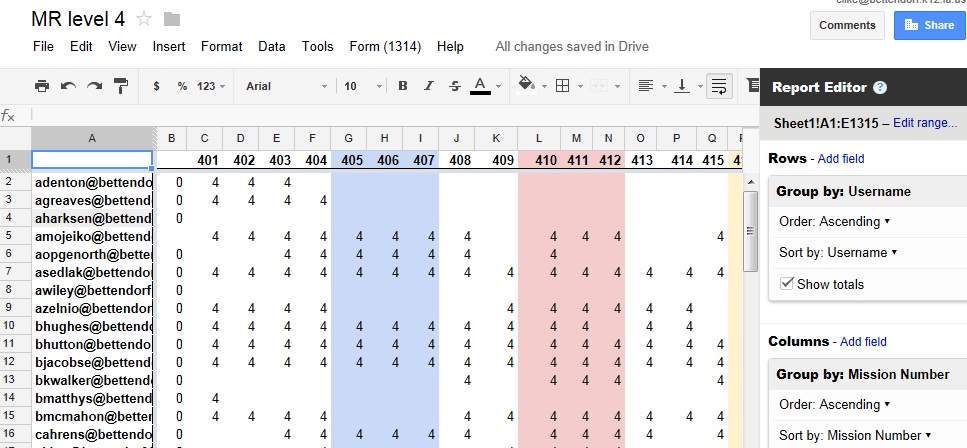
When teachers do a mission, they are to receive points depending upon which level the mission falls under. 4th level missions are worth 4 points, etc. I have to record that they did the mission, assign them the points, and then add up their total points. I do it all in google docs for the simple reason that I am comfortable with spreadsheets, and it's free. Here is how it is done. At the end of every mission, teachers submit a google survey to rate the mission's effectiveness. They have to put their mission number, and the survey records their user name.
This data then goes into a spreadsheet for that level. All 4th level missions have the same form on them. 5th level missions have an identical form that feeds into the 5th level point totals. I then create a column on that sheet that truncates the mission number to the first number. Thus mission 403 will be truncated to 4. This is where the mission number turns into the points awarded. 


I then create a pivot table that accesses this information with the teacher's username, mission number, and returns the points awarded. The final column on the pivot table adds the total number of points for that level. The different colors on the table allow us to keep track of chain missions. If someone does all in a chain, they earn a new title. 
The third worksheet on this document is where the totals are linked to the teacher's actual names. Basically, we have a list of names associated with the users, and an equation copies the total column from the pivot table to this "totals" spreadsheet. The equation used is a VLOOKUP, that looks up their username, and returns their total. 

Now that I have their real name associated with their point totals from that level, I simply copy each of the point totals to a different "Leaderboard" spreadsheet. It has columns for each level, and adds the numbers in the end. The actual leaderboard simply references that sheet and is displayed for the staff. 

Easy peasy.

Let me know if there are any questions. If I get ambitious I may do a video tutorial on how this is done to show you around myself. 

Chris
@christopherlike


Monday, March 11, 2013

Gamifying a Classroom: Step 2

Earlier, I posted that I have been looking at applying the principles of gamification to a classroom experience for my students. I started with the idea of revolving the class around a Star Trek-like world where students would be earning ranks by fulfilling achievements. I began a website here.

I am planning this for my Astronomy class, in a unit that is rough for them. The underlying topics to be covered are Electromagnetic Radiation, Spectroscopy, Doppler Effect, and Telescopes. It is basically the "science" part of astronomy in terms of what principles astronomers use today.

The basis behind the game is that students will enter a classroom that is to prepare them to be the captain of their own starship. They begin the game as Cadets, graduate to Ensigns, then Commanders, then finally Captain. You can read more about this on the site or the previous post. 

I have worked out a pretty cool advancement tool that I am going to incorporate. I plan on taking some safety pins that they can attach to their school issued lanyards. Upon completing a level, they will be given a bead to place on the pin (think cub scouts). The color of the bead will indicate their level of completion. For instance. If they pass their advancement exam on their first attempt they will be awarded the title Cadet 2nd Class (Blue Bead). If they complete the enrichment exercise, they will advance to 1st Class (White Bead). If they fail their bar exam, but pass it on their second attempt, they will be considered Cadet 3rd Class, but can move up to 2nd Class by doing the enrichment exercise.

Thus by looking at their pin, they have their rank right on their chest.

0 beads - Cadet
1 bead - Ensign
2 Beads - Commander
3 Beads - Captain

1st Class White (Passed test on first try and completed enrichment)
2nd Class Blue (passed test on first try)
3rd Class Yellow (Failed test on first try but then passed)
4th Class Red
5th Class Black

Let me know if you think this is a good idea or if you have something that will make it better. I am seriously thinking about trying this in late April with my astronomy class. It will take a lot of work re-writing labs and resources to give them a Trekky feel, but it is timely with the reboot of the movie franchise. I will post more when I have more. Any feedback on the development of this would be appreciated.

Chris
@christopherlike

Thursday, March 7, 2013

Crowdsourcing Your 1:1 Professional Development

In an earlier post, I talked about a professional development model that I created for my district based on gamification. We call it Mission Possible, a game-like system where teachers work through "missions" in order to gain achievements to reach higher levels of tech greatness. Read more here! I kind of left you hanging with the second part of the PD that I feel makes it successful.

Crowdsourcing is a big part of the model that individualizes the PD to departments and even specific teachers. I am not sure how Webster defines crowdsourcing, but I can give some pretty good examples.

Astronomers, in an effort to map the sky have taken pictures of millions of galaxies with telescopes like Hubble, or the Keck Telescope in Hawaii. The next step in their experiment was to categorize these galaxies as spiral, elliptical, irregular or peculiar using Hubble's Galaxy Classification system. Basically you would need to look at these pictures, determine if there were spiral arms, or other things happening that would put the galaxy into a certain category. As it turns out humans are much better, even after simple instruction, than computers at doing this. Astronomers had a problem. With the six grad students working on the experiment, they could not look at the MILLIONS of galaxies. They created Galaxy Zoo. This website gives anyone a brief intro to how to classify galaxies, then shows them pics and has them practice. Using some simple questions, they use people around the world to classify actual scientific data. Within 24 hours they were getting 70,000 classifications per hour, using over 150,000 people in the first year.

With Mission Possible, I wanted to have missions that were specific to disciplines around the school. I am not an expert in Foreign Language, so I go to the experts. They can progress in the game by earning points creating missions for others. As part of the game, a teacher creates their own tutorial, shares it with others, and contributes to the actual making of the game.

I believe that this ownership of the game itself is a big part of the buy-in we get from our teachers. It is not a game where I or some Tech God who know everything is telling them what is important to learn in tech. No one knows every application of tech in our school. There are pockets of experts that I am tapping into with the crowdsourcing missions. Teachers realize that the game is theirs to play, and create as they go. The tutorials are there for other's use, which gives the teachers recognition and a part of the satisfaction that I feel in the success of the game.

I know there are a lot of you looking to adapt this model in your own systems. Do not forget the crowdsourcing piece as it will help you with manpower as well as buy-in. Good luck and let me know how it goes.

Chris
@christopherlike

Wednesday, February 20, 2013

Mission Possible: Playing Games with Professional Development

A few posts ago, I talked a bit about Gamification in education. I then went on to discuss an idea I had to apply this to my classroom with Galaxy Fleet. After presenting at last weekend's Iowa Edcamp, I am inclined to give you some specifics of the Professional Development model I created that uses these principles.

Mission Possible is our district's model for professional development with regards to technology in our 1:1. In creating this process, I was looking for something that was highly engaging (or as engaging as any PD can me) as well as individualized and fun. Teachers were coming into our 1:1 initiative at many levels. We had those who could not wait to get their hands on their iPads, and those that never planned to take them out of the box. I needed a system that would challenge the high flyers while bringing those indifferent to the technology into the fold.

I see learning technology to be three fold. First there has to be a time where you simply get comfortable using the device or programs. In the game, this is where teachers begin. Level 1 teachers are given the title "Noob", a distinction that they no doubt want to shed as soon as humanly possible. Upon reaching level 3 in the game, they are considered "Users". I see users as teachers who are not afraid to turn on a computer or device and use it, but may not know exactly what to do with it. They want to play with different apps, find already developed programs to use, and master them. User levels (3-6) are where most of our teachers currently sit after about a year into the program. Upon reaching level 7, we start referring to teachers as "Tech Geeks". These people are comfortable finding apps and using them. They don't need any more in-service on what is out there or how to find it. Their levels shift to how they are going to implement these strategies into their classes. They collaborate with other Tech Geeks to infuse the technology or they share their expertise with others by leading sessions on in-service days.

Those are the three Tiers of the game. The mechanics follow real basic gamification principles. To gain a level, teachers do "Missions." Missions are set to take about 15 minutes each. A level 1 mission earns the teacher 1 "Paw Point" (we are the bulldogs). Once they reach 10 paw points, they lose the noob status and become a level 2 novice, on their way to being a User. Level 2 missions are worth 2 paw points each, level 3 worth 3 and so on. Teachers are not allowed to do missions above their level, but can "farm" lower level missions for small amounts of paw points.

Here is the website for the Game. 

You will not be able to see the leaderboard, which we do post so everyone knows where they stand. At the onset of the game I made a couple of things very clear with both the teachers and the administration. First, this is NON-EVALUATIVE. At no time will an administrator come to them and ask why they are only 5th level. I am a firm believer you get from Professional Development what you put into it. The only requirement that teachers have in the game is that whenever they are given time to do missions, that they put forth their best effort. Second, the game is really on the honor system. No one is going to be standing over their shoulder watching them do missions. Again, you get out what you put in.

I can tell you that this posting of the leaderboard is a key to the game aspect of it. It engages teachers' competitive nature just like Call of Duty does with my eldest son. The guy at the top will not let others ahead of him, even though they try. Some don't want to be at the top, but they always want to be ahead of that person right above them. The level of interest has dwarfed my expectations.

As teachers move through the game they can pick up other titles along the way for completing sets or "chains" of missions. If a teacher does a set of 5 missions on twitter, we give them the title "Twenius" on the leaderboard. This allows others to see who are experts on programs they might be interested in. They can seek them out instead of the tech department.

I encourage you to develop your own game based on this model. I am not selling the idea, I am giving it. Use it, make it yours. In doing so, I can give some advice. Keep it light; keep it fun. Name the missions with cute names like "Mickey Mouse is Pissed" for copy write, or "How do I put my face on Jennifer Lopez's body" for paint programs. Put effort into selling it to admin before the teachers. Time is always the biggest issue. Some teachers will do missions at night while sitting in bed, but most will only have time to do them when given it by admin. Be sure you have their support before selling it to the teachers. Celebrate successes. We always tweet out when someone raises a level. We have given prizes like earbuds to everyone who hits 5th level, or stylus's to the first 5 who hit 7th level.

Crowdsource the making of the missions to your teachers. Upon reaching level 7, teachers are beginning to help in making the actual missions, or ratifying earlier missions to make them better. I do not have the time or expertise to make missions for apps in all the different disciplines in my school. I let others do the work for me. I can post more on this later, but it is a big part of what makes Mission Possible actually possible.

As for the back end to this, I did it in Google forms and spreadsheets. Why? They were free and I kind of knew how to use them. If a programmer reads this and wants to write a database that keeps better track of these things, please do and share it with me. If you are interested in seeing the data side of this, please let me know and I can post something on that later.

That is an overall look at the game. I have presented this at a couple of conferences and can tell you that the idea is spreading like the clap at Woodstock. Grant Wood AEA is trying to develop something, I have had talks with the Des Moines School District, as well as Dubuque AEA and several smaller districts.

Let me know if there is any way I can help in these or other endeavors with this idea.

Chris
@christopherlike

Tuesday, February 5, 2013

Gamification with Students: Galaxy Fleet

Alright, this is a bit out there, so try to read through the whole thing before passing judgement. I will tell you that this is only an idea, still in the "It may be cool if I try this someday" stage. It may be something great or may fail miserably. Hard to crystal ball that kind of thing.

If you read my previous post on Gamification, you were introduced to using game dynamics in a non-game setting. I have done this for staff PD and it has been very successful. This is my first attempt at planning something for students. After talking with our Physical Science teacher Breelyn McMahon, I tried to develop a unit based on a game. She encouraged me to include some standards based grading, which I think was a great addition to the concept.


Here is the premise for a physical science unit on Electromagnetic Radiation. The students start out as Cadets training for Galaxy Fleet- a futuristic military academy. (I am trying to give this a Star Trek feel.) They begin by being trained to become Communications Analysts (Ensigns). In order to gain this recognition (which I plan on doing with virtual metals) they need to pass their bar exams. These exams would consist of three quizzes, one conceptual, one multiple choice, and one mathematical (or performance). I basically broke the unit exam into three parts. They have to pass at least two parts with 75% or they have to retake them. After becoming an Ensign, they strive to pass on to Commander, and then Captain of the ship.

In order to even take the Ensign exam, they have to earn "commendations." These are earned by passing standard classroom activities. If a student finishes a lab, they earn a commendation...  if they finish their homework, they earn another, etc. Once they have 3 commendations, they can take their bars. If they fail one or more aspect of the bar, they lose a commendation, which must be then earned back before they can retake the exam. This could be done with a remedial lesson or worksheet to review what they need to know to pass that part of the exam.

The lessons are all based on the Learning Cycle approach. Students will earn a commendation for their exploratory activity, their concept development activity, application activity, homework and such. The lesson would be planned and executed with sound science teaching methods of discovery and inquiry.

Here is the basic outline of how they could become an ensign.


  1. Pass the "Lost in Space" exploratory lab to learn types of ways in which we can communicate (what a wave is) 
  2. Pass the "Keeping Time with Pendulums" lab to learn vocabulary (amplitude, wavelength, frequency, etc)
  3. Do some homework associated with the previous
  4. Pass the "Wonderful, Wonderful Toy" lab with Slinky springs to understand the types of waves out there as well as reinforce vocab.
  5. Earn 3 commendations and take their bars. If they pass 2 out of 3 of the formative quizzes they reach Ensign and they do the application activity "It Sounds Good, But What Does it Mean" lab with standing waves. 
  6. If they fail a part of the bar, they do some remedial worksheets to earn back the commendation to take the bar until they pass. As these students are doing this, the ones who passed will be working on the application. 
  7. To get them all at the same level, we added an extension activity for the ones who passed to do while the others are doing remedial work and retaking the bar exams. 


Those set of activities would cover one standard in the unit. As a Com Analyst they will be exploring more about electromagnetic waves until they take their exams to become a Security Specialist (another standard in the unit). After that they will be applying what they know the to lasers on the ship, reflection, and refraction of materials to protect the vessel (a last standard in waves). If they pass out of that they can take their overall exam to reach Captain status.

Here is a link to a website I began to make for this. I included some preliminary lab activities and a description of the game. Note the feel of the writing. I may expect them to call me "Sir" as their commander and ask them to stand at attention when I enter a room, etc. Maybe I will wear a ribbon or jacket or something. It may be fun (at least for me). I envision having ceremonies at the beginning of class when someone earns their new rank, maybe having a website with kid's profiles/rank/commendations/etc to allow them to showcase their accomplishments.

This would cover maybe three or so weeks of class (on a full block each day), with exams at the end of each week. Some of the activities take 10 minutes while others may take a full day. The quizzes would be designed to last about 15 minutes each with the Captain's exam (the comprehensive one) being a full exam at the end of the unit. They can't progress unless they show they have met earlier standards on the formative quizzes though.  

The idea would be that the next unit in the class could be based on a different theme. I think students would get tired of Star Trek for 9 or 18 weeks. Perhaps we do a medieval theme, or spies depending on what the unit is. A unit on chemistry would be great for a detective/forensic angle, and a unit on motion could be done with designing roller coasters.

That's it!

Any thoughts would help in doing this. Do you think students would like it or hate it? Any ideas for adding to the game? If I didn't explain it well enough, please comment and I can try again.

As I plan to do a lot in this blog, I am just throwing out ideas. If you like it, run with it and let me know how it goes. I am still on the fence on this one as it will take a lot of time to put this into use.

Chris

Monday, February 4, 2013

Gamification in Education: It's World of Warcraft without the Warcraft.

...Well maybe with a little warcraft depending upon how you roll.

I first came upon the idea of Gamification from my brother, an IT guy working in the business world. I was telling him that my district was asking me to develop the professional development for our 1:1 initiative. I told him that I was looking for something new and innovative, something that will engage the teachers in my high school that was ongoing and individualized to teachers' needs. He mentioned this idea that had been around in the business world for decades: Gamification.

Gamification is the idea of using game dynamics in non-game scenarios. Basically it works like this. Video games and role playing games outline overall goals that they want you to achieve. They then design specific tasks that you do in order to work your way towards these goals. (Sounds a lot like my classroom) I have witnessed my son playing for hours on the computer, fighting bad guys on the game DC Universe. If you ask him what he is doing, he will tell you that he has to defeat enough Joker goons to gain experience to gain a level. What is at that next level? More Joker goons! Seems odd, but if I could engage my teachers (or students) at 1/10 of his level, I am doing great things.

Gamification has existed in business for decades. Karate has its belts. You perform a set of tasks and you are rewarded with a darker pigment around your waist. Airlines have frequent flyer miles, Discover card has cash back, and I can't turn the TV on without hearing about some reward my wireless company is giving out. These are all aspects of gamification.

Long story short, I devised a professional development for our staff based on this and other important principles. I am going to save this for a later post. We called it Mission Possible and it is working very well. I have presented it at a couple of conferences where it has been very well received and even have an article being edited for publication in Tech and Learning. More on this later.

At one of my conferences, I was asked if I had ever tried this with students. As I had spent so much time working on the PD, I had not yet developed anything for kids. I know there is a guy at Classrealm who has been developing some stuff, but I had not worked on it for myself. Bouncing ideas off another teacher in my building, I began to work on something special. I am pretty excited about it, but since it is a complete new look at managing my classroom, it is a little scary.

I will outline what I have for you tomorrow.

Chris