Showing posts with label technology. Show all posts

Friday, October 18, 2013

#Iaedchat on Gamification


#iaedchat Gamification in Education

(Note to self: make a better face when starting your video if you are going publish it for others to see)


The following are links to pages on this blog if you are interested in developing your own game. If you have intentions of going down this path, please hit me on twitter or email. I am more than willing to consult with districts on their games. I have worked with several districts who have begun to develop their own games.

Gamification Intro

Mission Possible: Our Professional Development Game


Mission Possible Overview

Crowdsourcing Your Professional Development

The Back End of Mission Possible

Mission Possible: Behind the Curtain (Video)

Link to our Mission Possible Site

Galaxy Fleet- Gamifying a classroom

Gamification with Students: Galaxy Fleet

Galaxy Fleet 

Galaxy Fleet T-1 day.. This then goes on for several posts dealing with how the model worked in the classroom.


Please let me know if there is anything I can do to help. Good luck!

Chris
@christopherlike

Sunday, September 8, 2013

Mission Possible 2.0

I recently published an article in Learning and Leading with Technology outlining my work on Mission Possible. Let me tell you that my emailbox/twitter/blogger has been full ever since. I can not thank all of you enough for your support of my model, or express the delight I have in hearing all of the innovations that have come from this simple linking of ideas.

If you follow this blog, you will probably noticed that I have not posted much in a long time. Right now, I am in the middle of golf season, trying to teach an overfull schedule including biology (not my fave), and keep up with the enthusiasm surrounding the globalization of Mission Possible.

With that, I am always willing to help all of you in any way I can. With the volume of requests I am getting it is making it hard for me to put in the effort I believe you need from me in beginning this process. When confronted with this kind of problem, I face it down like a heavyweight.

I have decided to kick the help I offer up a notch. If you are serious about starting a game, I believe whole-heartedly that I have experience to offer. I am willing to work with you virtually, as I have been, but truly believe that I could do more help working with your people face to face. I have been approached, and am willing to work as a consultant on beginning this process. If you have a small amount of funds to get me there, I can find time to work with your people; be it teachers, tech staff, or administration. As you all know, I am giving my model, my files, and my ideas away for free. I will never charge you to use the idea, but I do want you to succeed and think I can help.

As for Mission Possible 2.0, I have some new items on my agenda.


  1.  I am working with some programmers to make the back end files more self-serving, using advanced formulas and trying to get the points to add up easier.
  2. I am also working with programmers to try to find a way to upscale the model for larger districts. I am looking at Microsoft Access for the database, infused with google sites or wordpress.
  3. I am beginning to implement "Achievements" as a new reward system in the game
  4. I am looking at the upper levels and expanding them to include more choices for teachers. 
  5. I am finding new ways to reward teachers for their accomplishments. 
  6. I am working on trying to incorporate social media as a more integral part of the game.
If you follow our site, you will see some of these changes as they are being made. This kind of thing is never finished, it is only made better. If you would like to discuss my ideas, please respond here as always, hit me on twitter, or chuck me an email. 

Cheers,

Chris
@christopherlike
christopher.like@gmail.com


Friday, August 23, 2013

(Video:) Mission Possible- Behind the Curtain

I know it has been a while since I have contributed anything to this blog, but I thought it was time. I recently was fortunate enough to get an article published in Learning & Leading with Technology. Since then, I have gotten several emails and calls about how I run the back end of the program and thought it may be nice to put my thoughts to Youtube and try to answer any questions that come up.

When I did this, it was using free software and knowing very little programming language. If anyone who knows more about computer programming than me (which is probably all of you) and wants to help out on this project, I would love to find a way to better keep track of these totals.

That being said, here is a quick and dirty run through my model.


If you have any questions, or would like me to go further into any part of the model, please let me know and I will try another screen-cast. I have also meet several times on Google hangouts or Skype with interested parties.


Chris

@christopherlike

Friday, May 24, 2013

Wrapping up gamification in Astronomy

Many of you have been following the implementation of Galaxy Fleet in my astronomy class. This experiment was conceived after the development of Mission Possible, it professional development model for technology PD. The process of applying gamification to my classroom had very distinct differences to applying it to our staff.

Most notibly, I was alone. In developing Mission Possible, I was fortunate in that I was surrounded with people who were excited about the idea. Leanne Wanger, our teacher-librarian was instrumental in the implementation of Mission Possible, and my principal Matt Degner's trust and leadership was essential. With Galaxy Fleet, I was alone in the development of the structure, the activities, the exams, and the back-end bookkeeping. 

Student Reaction:
In keeping updates on this blog, I was focused on the student reaction the process as we went along. I made adjustments on the fly if things were not going well, always kept upbeat about advancement through levels, and made Bead Ceremonies as public and special for everyone. It was nice to start a day by saying "Please join me in congratulating Joe Smith on earning his silver Ensign Rank!" The kid would come forward, be presented with the bauble, and shake my hand. The class liked the individual recognition of their peers.

Today I looked over the end survey for the class.
The comments spoke a very similar story. When asked if they enjoyed the gamifiaction model or they think I should throw it out, a vast majority said they would like to see it stay. Most of the comments revolved around it being fun, a great way to motivate students, and helped them learn the material. Many of them liked the testing procedure where they took several smaller tests instead of one large chapter exam. Even if I decide to not do Galaxy Fleet, I am going to give serious thought to keeping aspects of the testing procedure.

Some students mentioned how competition was a great motivator for them, and that this transition was easy because many of them play video games based on the same principles. They enjoyed trying to reach a level and gaining the recognition as they went.

That is not to say that every student bought into the idea. As you can see from the above graph, four of them were not interested in the game at all. In the comments, one wrote that if he/she wanted to be enlisted in ranking exercises, they would join the army, not take an astronomy class. One mentioned that there was a lot of things to remember in the labs, exams, and homework that was assigned. They had a hard time remembering to do all of it. They also felt frustrated in not reaching levels, wanting to drop the class because they felt they couldn't get anything right. These kind of comments concern me, and can not be fluffed off as outliers in the average.

Grade-wise, the students probably did better under this system, however, it is hard for me to attribute that to the game, or the fact that I took several more days to teach the material. I would say that the game motivated several kids in a way that I didn't have to personally keep them on task. However, if I took the same amount of time in my traditional learning cycle structure, I may have had similar results.

Overall, I am at the point in the process where I look at next year. Do I do this again? What changes would I make? I believe I have learned a lot about what motivates kids, how to tap into their competitive nature, and keep them focused. I am going to definitely keep some aspects of the game, if not the entire system.

I will keep you all updated.

chris
@christopherlike

Monday, April 29, 2013

Gamification Day 3 Recap

Friday went very well. They handled the lab activity better than most of the activities they did earlier in the semester. They were using light probes to make a graph of the intensity of light as distance increased. They then fit a curve to find that the relationship was an inverse square. That is pretty high level math for some of these students.

The first thing I noticed was that they finished the lab within the given time period. This is not normal. They knew that they would not be able to take their bar exams until the activity was turned in and thus they got it in on time. Some of my lower achieving students also focused on knowing how the lab was done and what the conclusions were. This was remarkable as in previous labs, if they turned it in, it was probably half done with little thought to conclusions.

Today will be a big day for the class. They will be taking their first bar exams. I am having them all take the multiple choice section, and then giving them an option to take either the free response, or the math portion. Many of them may take all three, but they are given the option. They need only pass two of the three to make Ensign, but passing all three gives them a brighter colored bar. I will truly get to see if these incentives are effective today. How many will choose to take all three? How many will pass on the first time? What will that do to their engagement if they fail? If they succeed easily?

I will let you know how it goes.

Chris
@christopherlike

Thursday, April 25, 2013

Galaxy Fleet Gamification Day 1 recap

Well I survived the first day of my classroom gamification experiment. This may have been the most important day of the lesson, the day I had to sell the students on the idea. Here are a couple of observations from that first day that I think I should share.

  1. I did not bring out the coat to turn myself into the hard ass admiral as I planned. I ran the class as myself, but as we got into the game I did joke about how I was thinking of using the character. They thought the yelling and the southern accent was pretty funny. I will pull him out when the class needs some motivation (in a tongue-in-cheek kind of way)
  2. Overall they seemed to think of this as a pretty good idea. It is hard to get a read on every student in the room, but most expressed willingness to try it. 
  3. I heard comments from some of the best students in class that they were going to be the first one to the level of Captain. For the top end student, it took me literally four minutes to tap into their competitive nature. Lets see if it will hold for the entire unit.
  4. The mid-level students seemed to like the idea in general (most are "gamers" and the idea of gamification seemed natural to them). I think they are a bit hesitant about the amount of work that I am going to ask them to do, and the testing involved, but hopefully they will fall in line as we go. 
  5. I have a group of lower-level students that concern me the most. There are two sects here. There is a group of four that sit in the back, do little work, and thus do poorly on exams. I know for a fact that these are smart kids, who have the ability to learn this. However, they are disenfranchised with high school in general and thus are the hardest to motivate. I have been working with one of these individuals a bit lately, talking to him about being a leader of his group of friends, and how he can help focus their attention. I am happy to say that out of all of the students in the class, he was the most excited about the game on that first day. I think he wants to do well, but for some reason that is not "cool" with his friends. This is giving him an avenue outside the normal school-type functioning, that he can embrace. I will work on him a lot through this experiment. 
  6. The other sect that worries me are the students who feel that they are not smart enough to do the astronomy. They feel that their background, especially in math, is hindering their learning. It is my hope that both of these groups of low-level students can feel some successes in the lesson as they go and that that success will carry them to learn the material. 
  7. I will say that the game is also fun for me. Having created a "Star Trek-like" game, I made myself the commander. I asked them to call me "Sir" or "Admiral". That is fun in itself. They stand at attention when I enter the room, which really is a cool feeling. 
Yesterday we did an intro to EM radiation with the activity Lost in Space. Today we will be exploring the EM Spectrum and beginning an activity on the Inverse Square Law. 

I will let you know how it goes.

Chris 
@christopherlike

Tuesday, April 23, 2013

Gamification of Classroom T minus 1 day!

I am planning on starting the gamification of my Astronomy class tomorrow and I am getting nervous. If you have not been following this blog you can find information on the planning stages here and here, and you can get to the site I set up for the class here.

That being said, I plan on blogging updates on this every day for the duration of the experiment. Today is T minus one day!

Over lunch, I will be going to Hobby Lobby to retrieve the beads and pins for their level awards. Nothing like waiting for the last minute!

I went through my schedule on how I believe the day to day progression is going to go and I came to a realization... I need 19 days for this and I really only have 10! With the addition of several activities to round out some abbreviated learning cycles, the timeline for this curriculum has grown much more than I anticipated. I spent an hour this morning paring down the days in an effort to lessen the blow the other units I need to cover before the end of the year. I have a schedule now that is 14 days long, which I should be able to make work.

We shall see. Feel free to give comments or suggestions as I go. I will try to get some pics and such as I go.

Wish me luck.

Chris
@christopherlike

Wednesday, April 17, 2013

If Twitter is the Answer, What is the Question?

I recently heard George Couros (@gcouros) speak to our K12 staff about advances how our society utilizes technology and how our schools need to catch up. I have to say that I agreed with most everything he said. I am obviously a blogger, believe that we need to foster 21st century skills in our kids so they can compete in a global economy, and firmly believe in giving back to my profession. Last year as the keynote speaker at our National Honor Society induction I urged the students to create something (ala #Starwarsboy). Needless to say on most respects Mr. Couros and I seem to be cut from the same cloth.

That being said, I want to address a twitter issue. I call it a twitter issue because it is becoming an epidemic in teacher circles. So much so that the teachers that probably need the good attributes of the media platform want nothing to do with it. Mr. Couros stated that "If you are not on Twitter, you are becoming illiterate." Many of those I follow on twitter are engrossed in the wonderful things that twitter can offer. They have encouraged its use by others to a point that it is starting to have a backlash around the water cooler. I am not being critical as I do use it in edchats, have connected with some great educators, and have gained some followers that are probably reading this right now because of it. I think twitter can be a good thing. It has been a good thing for my professional development.

Twitter doesn't address the real problem though. The problem, as I see it, is that many teachers do not feel a need to better themselves using any method. There are many reasons. Time is the biggest. With grading papers, planning for the next day, calling parents, running a class, meetings, and initiatives it is hard to find time to devote to your learning. Some have done very well in the profession and feel they can ride out the rest of the ride, and some think they knew it all coming out of college.

Many of us do see the need to keep up. Before blogs, twitter, news feeds, and online publications, used to get peer reviewed journals in the snail mail. We know that education changes and that attending a conference once a year is not enough to know your profession. We wrote (and still write) articles to educational journals, do research in our classrooms, and share back to the profession. When I started, I knew very few in my building that did this kind of activity. This kind of intrinsic professional development was the realm of college professors, AEAs, and department of ed committees.

What we need to recognize is that that has changed. Giving back to the profession should be a regular part of the job. I write this blog as a way to do that. I recognize the importance of giving back to the profession and that is how we as a nation will get better. I feel like I am being a teacher in writing this and I make time even though it is precious.

Yes, twitter is an avenue to do this, a good avenue really. I use it regularly and I believe that. But it is not the only avenue. Mr. Couros's quote is not unique. Many more like it sail around the ether of RT-land spreading like the flu. What those kind of quotes do is divide our profession into followers and dissenters.

If we want real change in our teachers I feel we need to encourage them to grow using the exploration of whatever kind of media a person feels comfortable with. Zite, Flipboard, Google Reader, News Sites, the Dept of Ed Website, or online publications can do this in some ways better than twitter. I have been encouraging those around me to read these kind of things, to keep themselves current to what is going on, and to join in on the conversation. I have seen in the last decade, even in the last year, how much more accepting teachers are of new ways of learning for them and their students. I know we have a long way to go, but when I find myself reading blogs on educational policy instead of watching Netflix, it amazes me how far I have come. I look at all of the social media and news sources I read in a day and still realize that most of my opinions are made by talking to real people, face to face. We discuss issues, we probe problems, and refine our thinking in real time.

I worry about relationships in social media. We are not walking through this technological adolescence, we are running blindly. I dig you guys, I really do. I enjoy having followers on twitter and hearing from people who read this blog. I have no problem carrying on a dialog involving education, but I, and you have to know that that is not a conversation. It is not a conversation when you can script what you are going to say, edit and delete before you hit send. It is not a conversation when you are limited to 144 characters. I worry about our kids and how this will effect their relationships. Relationship dynamics are changing and I don't think anyone knows how that will effect us and our students. We can't forget those around us for those a half a continent away.

That being said, I am going to stop there and read a book with my daughter.

Chris
@christopherlike

Monday, April 15, 2013

Is Content Dead?

In 2002, I sat in on a colloquium at my grad school where a professor was speaking about the power of the Internet. He spoke at long length about how we are teaching students the wrong things. He argued that information should no longer be taught in our schools. Any rote information, be it the date of the signing of the Declaration of Independence, the number of Justices on the Supreme Court, or Newton's Laws of Motion, can always be looked up in a couple of seconds using the Internet. That was startling in 2002, but holds probably more validity now what I have the Internet in my pocket.

He argued that we should be teaching kids how to make better and better google searches and work on technology skills that will allow them to retrieve this information out of the ever-expanding mountain of data that is out there. He quoted statistics about how there are thousands of new papers published every day and that there was no way that anyone could keep up with the surging tide of knowledge that was flooding our world. Teach them how to get what they need when they need it, that was his philosophy. There was no need to actually know anything so long as you can have the information on hand when it was necessary.

I sat in silence in 2001 closing my eyes and hoping that his ideas would not pick up steam but fade into the black hole of educational reform agendas.

They did not.

I have read numerous blogs, several tweets, and sat through a few edchats to know that this loss of content knowledge is a real agenda on the minds of some educators. It has been over 10 years since this idea was proposed to me and my feelings on it have not changed. Let me spell out my reasoning.

Learning must occur in context. If put to the question, I would say that I am a constructivist in my educational philosophy. (If you do not know what constructivism is in education, you can always look it up. I am sure wikipedia has a great article on it.) I believe, as many educators and brain researchers do, that students learn by assimilating information to what they already know. In order to understand a concept, a person accesses some part of their brain where similar information is stored and links the new information to that.

In science, this is why identifying misconceptions is so important. If a student comes to us strongly believing in a misconception, it is imperative that that be drawn out before any new learning can take place. The experiences that we have had before coming to the classroom are just as valid to us as those we have in the learning environment.

I follow a learning cycle approach to teaching. I have chosen to stick with the simple 3-step model involving exploration, concept development, and finishing with application. This preliminary exploration phase is where I give the students a common experience for which we can draw new concepts from. In truth, I am asking them to access their preconceived schema and drawing out any misconceptions they have about the topic. This puts the learning in context with what they already have experienced, or in some cases fabricated an experience that the class can share in.

This is a missing piece in the "no rote learning" model. As an example. In 1999, I was offered a summer internship at the Mayo Clinic. I was to work in an orthopedic research lab studying cures for arthritis. Upon entering their lab, I ran across large research studies posted like movie posters on the wall. "Articular cartilage regeneration using periosteum" was not in my vocabulary. I understood two words in that title. It took me a while to gain the background knowledge, vocabulary, and skills needed to make a contribution to the lab. I was a smart guy, but this was completely out of my wheelhouse. I think over the summer, I may have done more harm than good in that place.

This is an extreme example. In all my schooling I was never introduced to these concepts and had to learn them from scratch. I was motivated to do so as I did not want to fail. I can only imagine what students would be like that had no rote knowledge to draw from.

There was a book published a while ago called Cultural Literacy- What Every American Needs to Know. In it, the authors outline basic knowledge that they believed American voters needed to know to contribute a contemporary society. They actually have a list of about 5000 words that should be in everyone's vocabulary. This goes to the other extreme, but I think there is some merit to the idea. In order for us to communicate, we need to speak the same language.

I was able to work at that orthopedic lab, as well as a particle physics research lab at the University of Iowa helping build the Compact Muon Solonoid in CERN, Switzerland due to the fact that I had a strong science background. I agree that students need skills in finding information, and that not everything can be taught in our schools, but a fundamental understanding of how the world works in necessary. Students need background information in order to learn new things.

Please comment and join in on the conversation. Where are you on the "content" spectrum?

Chris Like
@christopherlike

Thursday, March 28, 2013

21st Century Skills- A Missing Piece- Production!

If you have been following this blog, you probably know how big a fan I am of the learning cycle approach to science teaching. I run my classroom on a three step cycle beginning with an exploration activity, then the concept development, which is followed by an application of the content acquired.

I believe firmly that this model can and should be used in many teaching experiences. There is no reason why it should be less effective when teaching 21st Century Skills. I can tell you that when planning any learning cycle, the easiest part to breeze over is the application. The students already know the material, why spend more time making sure they can apply it? In truth, this is probably the most important step in retention of the concepts.

I am not saying that this is not being done in our classrooms with regards to 21st Century Skills. I believe it is. What hit me this morning in the shower (where I do my best thinking on Ed tech) was that we should be pushing higher end applications of these skills. Today's bright idea revolves around some examples that are currently not available in my building but I believe they should be. They are all favors of the same candy, simply presented in different wrappings.

1. Video Announcements- About 7 years ago, my building tried this. At that time, a class called TV tech produced a 5 minute video to be shown during announcements about once a month. That was almost a decade ago. Producing video has become so commonplace that there is no reason that students can not read the announcements every day on video. I envision a couple of students dressed well sitting across a formal desk delivering the announcements. Maybe once a week, they could do a sports story or cover the various clubs and activities out there. I have even thought about maybe allowing commercials when time allows that may provide some funds. (Interview a florist before homecoming talking about the best kind of corsage.) Our school newspaper is amazing in its production, why can we not do the same thing with video?

2. Video production- I would like to see a class where the students make a short movie. They work on a script, find some actors, locations, film, edit, and do post production. The software to do this is relatively cheap and easy to use. We have a lot of students who are doing this at home, or would like too. The school should support them with guidance and a venue to show off their work when they finish. How cool would it be to show these in our auditorium at on a night showing. Create posters, the whole deal. Our school plays are incredible, why can we not tap into those actor's ambitions with film.

3. Music production- I sat in an English teacher's classroom after school the other day when a student came in to play one of the teacher's guitars. This young man, who I knew from my astronomy class, picked up the three pounds of wood and string and pounded out two pieces of his own music. He belted lyrics that he and the teacher worked out together after school. I asked if he had ever recorded his music and he said he had some stuff at home. He also had a notebook of over a dozen other tunes that he was working on. We need to support this kind of ambition any way we can. I would like to see the school invest in basic studio equipment and make that available to students. How cool would it be to teach kids how to use a mixer, record tracks, and produce student made music. Last year I attended our talent show and was introduced to several students who were placing music on YouTube and even one who has a song on iTunes.

There are many more examples of the kind of thing that I am talking about here. We currently have a class called Planetarium productions that tries to fill the production void in our school. Students have 9 weeks to write a script, make the visuals, record the music and narration, and program the planetarium to produce a show. It is a great class that students really enjoy taking. In the end they have a show that we use in our planetarium for other classes. Unfortunately As this is not a science Elective, it is usually the first thing we cut from our curriculum when we are short staffed. Also, this is a school-centered class, where students work for a purpose set by us. In the previous examples, the school would be working for the student to produce their own work. I can't think of anything more engaging that that.

I believe these are the type of things that people want us to be doing. They are Quadrant D, engrossed in 21st century skills, centered on problem solving, require timetables, are high in rigor, and naturally engaging.

If your school has these programs already, great! Please let me know how it is going and some of the successes or tribulations you are having. If you have other applications of real production going on in your school, please post a comment to let us all know what is out there.

Monday, March 18, 2013

The Back End of Gamification in our 1:1 Professional Development

I have posted several previous blogs on my model for gamification in our professional development. If you are interested in how the idea was started, read "Gamification in Education: It's World of Warcraft without the Warcraft." or "Mission Possible: Playing Games with Professional Development." If you are interested in how I incorporated crowdsourcing into the game, read "Crowdsourcing your 1:1 Professional Development." If you are interested in how I keep track of the points on the back end of the system, continue reading on:)

I will begin by saying that this is by no means the best way to do this. I am not a programmer, I am a physics teacher. My programming skills are completely self-taught and consist of some flash action scripting, enough html to be dangerous, and enough C++ to know that semi-colons are very important. I was talking to my nephew yesterday. He is a computer science major at the University of Iowa. I may have talked him into trying to develop the data analysis of this game for a class project he is doing for his degree. In fact, when Des Moines came to me and asked to see my programming mojo, I told them to hire someone smarter than me to build them an app.

That being said, here is a peak behind the curtain.

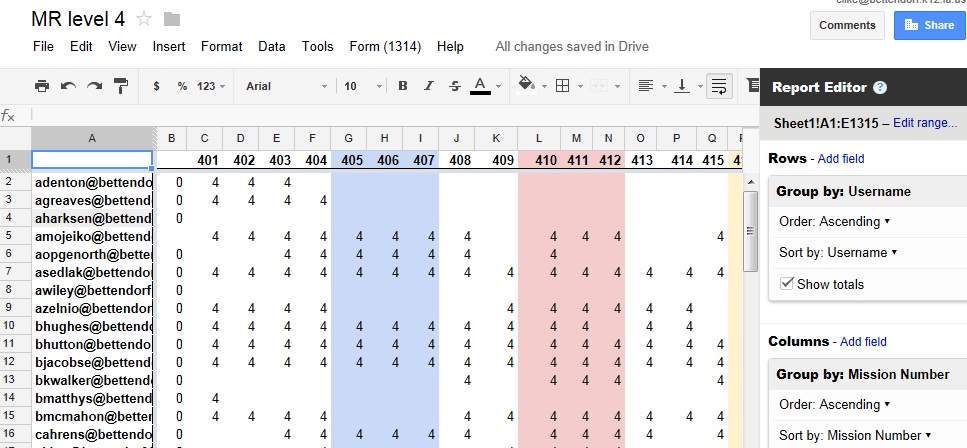
When teachers do a mission, they are to receive points depending upon which level the mission falls under. 4th level missions are worth 4 points, etc. I have to record that they did the mission, assign them the points, and then add up their total points. I do it all in google docs for the simple reason that I am comfortable with spreadsheets, and it's free. Here is how it is done. At the end of every mission, teachers submit a google survey to rate the mission's effectiveness. They have to put their mission number, and the survey records their user name.
This data then goes into a spreadsheet for that level. All 4th level missions have the same form on them. 5th level missions have an identical form that feeds into the 5th level point totals. I then create a column on that sheet that truncates the mission number to the first number. Thus mission 403 will be truncated to 4. This is where the mission number turns into the points awarded. 


I then create a pivot table that accesses this information with the teacher's username, mission number, and returns the points awarded. The final column on the pivot table adds the total number of points for that level. The different colors on the table allow us to keep track of chain missions. If someone does all in a chain, they earn a new title. 
The third worksheet on this document is where the totals are linked to the teacher's actual names. Basically, we have a list of names associated with the users, and an equation copies the total column from the pivot table to this "totals" spreadsheet. The equation used is a VLOOKUP, that looks up their username, and returns their total. 

Now that I have their real name associated with their point totals from that level, I simply copy each of the point totals to a different "Leaderboard" spreadsheet. It has columns for each level, and adds the numbers in the end. The actual leaderboard simply references that sheet and is displayed for the staff. 

Easy peasy.

Let me know if there are any questions. If I get ambitious I may do a video tutorial on how this is done to show you around myself. 

Chris
@christopherlike


Friday, March 15, 2013

Observing a Technology Integration Blog for 1:1

There is a good chance that you are reading this because I put the words "Technology Integration" or "1:1". This is my 26th blog on this site. I have a few followers that I think are pretty loyal to at least opening up the page and skimming it. I also probably have a few lurkers who catch my post on twitter and check out the page if it looks interesting. I also have a few random blog seekers who run across key words I label on the posts. 

Here is the observation I have made. In looking at my posts, I get almost a 300% increase in viewings when the post title includes something to do with technology. Crowdsourcing your 1:1 Professional Development holds the title for the most views, almost tripling any other post. Posts on pedagogy or developing relationships with students get little to no views. Apparently if I want my posts read, I need to place as many buzzwords into the title as possible. 

I believe the reason for this is fairly apparent. Those of you reading this Blog are probably tech-savvy and are interested in learning more about technology. Thus you read the blog posts that deal with your interests. Makes perfect sense. Sites like Zite or Pulse allow you to choose what kind of news you want to read. These types of popular sites are focusing our learning on what we want to know. 

I have a few concerns with this. First off, the more specialized we become, the less rounded. I have seen this on some of the twitter #edchats that I have contributed too. What I have found is that when you get a bunch of us tech minded teachers together in a virtual environment, we do nothing more than preach to the choir. A few weeks ago, the topic of one of the questions on #iaedchat was how do we develop better relationships with our students. Far too many of the responses revolved around giving them iPads or other devices to foster online social networking. Really? I posted that we should talk to them. I believe that many times that the more we focus on the trees, we miss the forest. 

There is something to be said for those liberal arts classes we all took in college. Remember the class on Russian history that you had to take from 6-9PM on Thursday night that you hated because all your friends were at the bar? That class had a purpose. It gives you perspective on something outside your chosen field. I urge you all to check out some blogs outside your interests. Try to broaden your perspective beyond just integrating technology or movie news (which is about all I check). 

Secondly, if the only ones reading these blogs are those interested in technology, we have another problem. We need to try to get the rest of our colleagues to read, to write, to spread their ideas across the nation. There is more out there than tech blogs. You are reading this, but does the teacher across the hall subscribe to these kinds of things? There are a lot of teachers that are resistant to integrating technology into their classroom. Perhaps the first step for that person  is to get them using it for themselves. I would not spend the time writing these pages if I didn't think that they had some kind of value to people. If you made it this far down the page, you must think the same. How can we get your principal, or team teacher to expand out in the same way you have? The more people that contribute to the conversation, the more the forest becomes apparent. 

Thoughts? Post a comment on how or why you came across this blog. It may be informative to see why people put precious time into reading these. 

Chris
@christopherlike

Monday, March 11, 2013

Gamifying a Classroom: Step 2

Earlier, I posted that I have been looking at applying the principles of gamification to a classroom experience for my students. I started with the idea of revolving the class around a Star Trek-like world where students would be earning ranks by fulfilling achievements. I began a website here.

I am planning this for my Astronomy class, in a unit that is rough for them. The underlying topics to be covered are Electromagnetic Radiation, Spectroscopy, Doppler Effect, and Telescopes. It is basically the "science" part of astronomy in terms of what principles astronomers use today.

The basis behind the game is that students will enter a classroom that is to prepare them to be the captain of their own starship. They begin the game as Cadets, graduate to Ensigns, then Commanders, then finally Captain. You can read more about this on the site or the previous post. 

I have worked out a pretty cool advancement tool that I am going to incorporate. I plan on taking some safety pins that they can attach to their school issued lanyards. Upon completing a level, they will be given a bead to place on the pin (think cub scouts). The color of the bead will indicate their level of completion. For instance. If they pass their advancement exam on their first attempt they will be awarded the title Cadet 2nd Class (Blue Bead). If they complete the enrichment exercise, they will advance to 1st Class (White Bead). If they fail their bar exam, but pass it on their second attempt, they will be considered Cadet 3rd Class, but can move up to 2nd Class by doing the enrichment exercise.

Thus by looking at their pin, they have their rank right on their chest.

0 beads - Cadet
1 bead - Ensign
2 Beads - Commander
3 Beads - Captain

1st Class White (Passed test on first try and completed enrichment)
2nd Class Blue (passed test on first try)
3rd Class Yellow (Failed test on first try but then passed)
4th Class Red
5th Class Black

Let me know if you think this is a good idea or if you have something that will make it better. I am seriously thinking about trying this in late April with my astronomy class. It will take a lot of work re-writing labs and resources to give them a Trekky feel, but it is timely with the reboot of the movie franchise. I will post more when I have more. Any feedback on the development of this would be appreciated.

Chris
@christopherlike

Thursday, March 7, 2013

Crowdsourcing Your 1:1 Professional Development

In an earlier post, I talked about a professional development model that I created for my district based on gamification. We call it Mission Possible, a game-like system where teachers work through "missions" in order to gain achievements to reach higher levels of tech greatness. Read more here! I kind of left you hanging with the second part of the PD that I feel makes it successful.

Crowdsourcing is a big part of the model that individualizes the PD to departments and even specific teachers. I am not sure how Webster defines crowdsourcing, but I can give some pretty good examples.

Astronomers, in an effort to map the sky have taken pictures of millions of galaxies with telescopes like Hubble, or the Keck Telescope in Hawaii. The next step in their experiment was to categorize these galaxies as spiral, elliptical, irregular or peculiar using Hubble's Galaxy Classification system. Basically you would need to look at these pictures, determine if there were spiral arms, or other things happening that would put the galaxy into a certain category. As it turns out humans are much better, even after simple instruction, than computers at doing this. Astronomers had a problem. With the six grad students working on the experiment, they could not look at the MILLIONS of galaxies. They created Galaxy Zoo. This website gives anyone a brief intro to how to classify galaxies, then shows them pics and has them practice. Using some simple questions, they use people around the world to classify actual scientific data. Within 24 hours they were getting 70,000 classifications per hour, using over 150,000 people in the first year.

With Mission Possible, I wanted to have missions that were specific to disciplines around the school. I am not an expert in Foreign Language, so I go to the experts. They can progress in the game by earning points creating missions for others. As part of the game, a teacher creates their own tutorial, shares it with others, and contributes to the actual making of the game.

I believe that this ownership of the game itself is a big part of the buy-in we get from our teachers. It is not a game where I or some Tech God who know everything is telling them what is important to learn in tech. No one knows every application of tech in our school. There are pockets of experts that I am tapping into with the crowdsourcing missions. Teachers realize that the game is theirs to play, and create as they go. The tutorials are there for other's use, which gives the teachers recognition and a part of the satisfaction that I feel in the success of the game.

I know there are a lot of you looking to adapt this model in your own systems. Do not forget the crowdsourcing piece as it will help you with manpower as well as buy-in. Good luck and let me know how it goes.

Chris
@christopherlike

Tuesday, March 5, 2013

What Aliens Taught Me About Technology

Yesterday my astronomy II class was talking about life in the universe. Usually, this end-of-the-semester topic revolved around how aliens are going to kill us or how stupid Jar Jar Binks is. Yesterday surprised me.

I was going through the math on something called the Drake Equation. Dr. Frank Drake created a set of variables that allows a person to estimate how many alien civilizations there are in our galaxy. It starts with how many stars there are in the Milky Way, then has you estimate how many of those stars have planets, then how many habitable planets, etc. In the end you are supposed to come up with a number for how many alien species are out there that utilize technology great enough for us to have contact with them. (My class came up with 180,000,000 and we were pretty conservative).

Anyway, one of these variables is the percentage of intelligent species that use technology. The students had already narrowed their search down to planets with intelligent life. Now I asked them what percentage of intelligent species would develop technology. My surprise came when all 17 of these juniors and seniors emphatically said 100%. Intelligent species can not avoid the use of technology. How telling is that?

Technology permeates our student's lives so fully that they could not even fathom it not evolving. They are so in tune with the advancements in technology, that they take it as second nature. To them technology is not a set of things, but a fluid, ever-changing, and evolving part of their culture. They get it! Why are we so worried about teaching them what they already know.

Our conversation then revolved around how technology arose on our planet. After apes began banging nuts on rocks, they found out sharper rocks worked better, and then tools made it even easier. We talked about the rise of culture. Looking around the globe, different cultures developed their technology completely independently of each other. The Egyptians developed their hieroglyphics completely separated from the Chinese or the Mayans of South America. All of these cultures developed a written language, farming, engineering, and religious structures.

After about ten minutes of discussion, they had me convinced that technology is inevitable with an intelligent species. Carl Sagan, a hero of mine, once spoke of our age as a technological adolescence. He worried that we were playing with technology like kids playing with toys. He worries about us blowing ourselves up, which incidentally is the last variable in the Drake Equation.

Our schools are probably in the pre-pubescent stage. We have just been given these tools with little instruction on how to integrate them. We know that just like an alien culture, we can not avoid its use, but will we blow ourselves up before the culture of our school can cope. Changes in school culture is a slow, grinding process that takes years to develop. Technology will not wait for us.

Chris
@christopherlike

Tuesday, February 26, 2013

Power Point kills presentations

I don't know about you, but I would rather dance Gagnam Style barefoot on broken glass than watch another student power point presentation. The sight of the "Sunny Days" background with its creepy coppery solar smile makes my skin crawl. Sitting in the back of a semi-dark room listening to students read plagiarized material from Wikipedia while mispronouncing most of the words they don't know is about enough to make me give up teaching. Don't get me wrong, Power Point is a powerful tool when used correctly, but in the wrong hands, it can spell catastrophe for even a good presentation.

Here are my top 5 reasons for hating this program and all of its offspring.


  1. Presentation software is overused. It was cool in 1995 when a teacher could throw away their overhead projector and replace it with stunning pictures and swooshing text. After we all got over the fact that we could link sounds to our magically appearing text the program lost all its appeal as a novelty. Most of the features that these presentation software packages offer (sounds, backgrounds, transitions, etc) are more annoying than helpful. 
  2. Power point has become the presentation. If I wanted information in a file, I wouldn't ask you to present, I would read it on the Internet. A presentation demands a presenter. I want to see you present, as an expert in the subject. I want to hear the presenter, not read what they wrote. Students especially, spend too much time making the visuals for the presentation and no time practicing their delivery. I remember standing in my room with my outline practicing the presentation that I was going to give to my high school biology class. I would practice it with my family at night, not spend all my time putting everything I wanted to say on the computer and then read it to the class. 
  3. Power point is a crutch for not learning the material. Why should a student know what they are talking about if it is written up there for the class to see? They are not becoming experts in the subject, able to answer questions about their presentation. They are becoming readers of someone else's information. 
  4. Power Point dumbs down the world. I read an article a few years ago where a General in the Gulf asked his staffers how they spent most their time. They replied almost verbatim "I have been working on a power point for Friday's meeting." He realized that this was becoming a problem. You can not simplify war into bullet points. Something as complex as the war on terror can not and should not be simplified into three points on a slide. I am a firm believer in this. If we are trying to get kids to see connections in ideas, go deeper into concepts and ideas, how can then ask them to bullet their thoughts. Power point compartmentalizes ideas into slides and a timeline. Life is not that linear. 
  5. Students don't take notes anymore. They can always go get my power point online if they want the information. I can tell you this because I do this. If I am at a conference and the presenter gives a power point. I will be checking my email within 3 minutes of the start of their presentation. Many times the presence of the power point is a crutch for me as a learner just as much as it is for the presenter. Why do I need to listen if everything you said is on the file?
Don't get me wrong, when used correctly, power point can be a powerful tool. I am only saying that most of the time it is used linearly and with too many words. Show me pictures that add to what you say or enhance your presentation. Make it non-linear, mapping a web of pages that allows me to navigate it to where I want to go. If you are presenting, look at me, talk to me, make me believe that you know what you are talking about. If you don't I will tune out, probably roll my eyes, and be on twitter in seconds. I am no different than our students. 

We talk a lot about getting our students to write well. We worry about their grammar and spelling, their punctuation and their ability to express themselves in writing. How is it that we have no problem taking points off an essay if a student doesn't express himself correctly but if he gives a crappy presentation, we clap and score them on at least having the power point. We need to focus on presentation skills in class, holding students accountable for a poor performance. I read once that the fear of standing in front of their peers and presenting ranked right before the fear of death on some survey. Students need to know how to present, need to be comfortable in front of others, and have the skills to do so. 

As always, your thoughts are appreciated,

Chris
@christopherliketech