Showing posts with label lessons. Show all posts

Thursday, September 19, 2013

Today's Fix for Education!

So yesterday I was sitting through a meeting of the Governor's Task Force on the adoption of the Next Generation Science Standards. We spent the day being brought up to speed on the current Iowa Core Science Standards... their inception, intention, and development. I listened for many hours to the reasons that the standards were made, continued to refine my opinions of the feasibility of the standards, and their merit with respect to the NGSS. 

It was during a panel discussion with some of the writers of the standards that something occurred to me. It was a simple idea, common sense really, but so foreign to today's thinking that it was almost incomprehensible. 

The panel was discussing the elementary standards (something I am fairly well versed in even though I teach high school). They mentioned that they banded them to grade bands, and made them a progression, but limited in content due to the fact that elementary teachers have so many other things to worry about on top of science. For a moment I thoughtfully placed myself in the shoes of one of these elementary teachers. These are a group of people who work very hard with challenging kids, teaching them to read, add, think, spell, write, and grow into young adults. They are being pulled in so many ways that if I were them, there would be no way I would be able to keep anything straight, let along try to adopt new standards every few years. 

THE FIX: 
Why do we have separate standards in elementary for literacy, math, science, social studies, and all the others. Why don't we just have one set of standards that encompass all of these. For middle school and high school it makes sense to break standards into disciplines because we teach specific content areas. Why do we throw all of these different documents at our elementary teachers when they only have like 15 minutes of prep at a time. I believe that learning could be much more integrated in the younger levels if someone took the time to COMPLETELY ALIGN their standards. My son came home with a math problem the other day where he was supposed to read a histogram of kid's heights in a mystical class from his math book. Why could he have not done an experiment to take that data himself, plotted it, and tried to draw conclusions about age and height? I will tell you why... that is science and he was learning math!

I am not saying that teachers do not try to integrate this as much as they can; I think they do. I just think that if we write the documents for the standards in one form, they will not tend to split them off. I would hate to try to master all of those documents. Why not just have one?

Maybe I am completely out of my area here, but I think it is possible. I realize that different committees made each of the common core standards for each discipline, but why can't they talk to each other? Make the standards seamless, easy to use, and adaptable. Then let teachers find creative ways to meet them.

What do you think? I am off here?

Chris
@christopherlike

Friday, June 28, 2013

Next Gen Science Standards, a Need Unfilled

I had the opportunity to hear Dr. Steven Pruitt speak at Iowa's kick off of the Next Generation Science Standards (NGSS) this spring. Now, those of you who know me, or have read any of my earlier posts, should know that I am both the theorist (the talker) and the engineer (the doer). I seek out innovative approaches to teaching by lurching blogs and twitter like a squirrel in a bush hunting nuts. But like the squirrel, I am finicky. I won't eat anything. I also don't like to be force fed. Right now I am trying to decide if these standards, were tossed before me by Cinderella, or laced in poison.

Enough with the rodent analogies.

I am by no means an expert in these standards, but from my cursory study of them, along with my visit with Dr. Pruitt, I have come up with some opinions. 

1. Dr. Pruitt surprisingly makes a lot of sense! He stood before us for eight hours on a cold Iowa spring day giving more than 200 educators an overview of the history and purpose of the standards. He spoke of the need for commonality, the research background underlying then standards, and the intricate politics (or lack of) that went into the decisions made in their development. All in all, he made very good arguments, had research and reality to back up his claims, and was not afraid to tell us the shortcomings involved with their development. I left there trusting that the guy knew what he was talking about.

2. Dr. Pruitt made a lot of sense to 200 educators. I can tell you that, even with my BS glasses on, I came out of that day sipping the Kool Aide. If his goal was to get Iowa's educators excited about the standards, mission accomplished... if Iowa only had 200 educators. My biggest worry on the long drive back to Bettendorf, was how I was going to spread my enthusiasm for what was coming down the pipe. When I got home, I quickly realized that this was going to take some time.

3. Science is not Biology, Chemistry, Physics, and Earth/Space science. This was the brightest epiphany for me since that day. It was not Dr. Pruitt, but a particle physicist I know from Coe College that happened to be at the kick off that drew me to this realization. I had worked with Dr. Ugur Ukgun for several years, where he has led me though the intricacies of quantum theory and experimentation. That day, however, he wore a teacher hat. He had been engrossed in laboratory work at the University of Iowa for over a decade while getting his doctorate. Now he was looking for the brightest minds for his own labs. It hit me that this is the guy I am preparing my students for! I needed to pay attention. He said two things that strung a chord with me. He talked about scientific research as being non-denominational. He didn't consider himself a particle physicist, or even a physicist. He was a scientist. In his work, he needed very high level chemistry, astronomy, cosmology, and three other scientific disciplines I had never heard of. Science was not a set of classes, but a way of thinking about nature that is cross-discipline at its very nature.

4. Math is a language, science is a method. The other point that Dr. Ukgun made was that if a student was weak in science, he could work with them. If a student was not proficient in the language of math, he couldn't even talk to the student. Math is the language of science. He believed that if high schools focused more on math (and with that computer programming) they could pick up the science concepts later. This was rather humbling to me as I have devoted many hours to teaching kids science, but his point had some validity.

5. Performance expectations are not the same as standards. They don't just tell us what students should learn, they dictate what students should be able to do. They have the odd feel of Hogwart's potion making class. I am working on my contempt glare ala Professor Snape when a student's potion blows up in their face. I am joking of course, but there is an element of performance assessment that is inherent in them. My problem with performance assessment is that I am not ever sure how to ride the line between pass/fail and giving students too many points for "trying". I guess I will have to look into this. When I figure something out, look for a post:)

6. Lastly is the "Need Unfulilled" aspect of this post. Dr. Pruitt made it exceptionally clear that these performance expectations are not curriculum. They are not intended to be "how to teach", just end results. This is where the teacher comes in. I applaud his committee for giving us reign here to play to our strengths and devise what we feel effectively matches our strengths and individual student's learning styles. However, the amount of work needed to make this change is daunting.

Thus I call to you all again. I am going to be fighting through this for the next few years. So are many of you. Join me in the conversation about how this these standards are interpreted into daily work. I am "phoning a friend" so to say so that we can talk this over, hash it out, and do it the right way. I believe this has to come from teachers, not politicians. We need to take the initiative, something we didn't do with No Child Left Behind. The biggest problem with that legislature is that politicians thought it up and ruined it. Lets have this come from us. We have the guidelines, we just devise the game.

Chris
@christopherlike

Tuesday, May 7, 2013

Classroom Gamification Update

I realize that it has been a while since I have posted an update on the Galaxy Fleet game I am running in my class. I have few excuses except to say that keeping up with the game is very time consuming. Choosing to do this from scratch, with little back end support in place has proven to eat time quicker than a Sarlacc eats a bounty hunter. 

I have found that in order for the game to run smoothly, the students need to feel success periodically. This means that I need to be up to date on grading and awarding of points. The thing would not work if they did a lab activity and it took me three days to grade it, this forcing them to wait that time for their commendations, and therefore slow down the frequency of bar exams. I have to keep things graded everyday. Who knew this game would force me to be a better teacher! 

So where are we now? Of the 25 students in the class three of them have not reached Ensign status. That means that most of the class has passed the cadet bar exams with no less than a 70%. Granted, they could retake exams, but in my normal tests, there was no way 22/25 would have gotten a C or better. 

Of those who reached Ensign status, I have about half who have silver (extra work) status and one that got gold. This one girl who made gold passed all three of the exams on her first attempt and did the extension activity. I can tell already that there are a lot of Ensigns who want a gold bead when they hit their commander status. Since they can all get a gold bead, they truly are not competing against each other, only against themselves. They see her with her shiny gold bead and want that recognition. The game is putting wind in the higher achieving student's sails. 

What about the lower three who have not gotten there? I had a serious talk with them yesterday about their grades and the importance of putting in effort in class. Their stalled movement through the game has given me an avenue to breach the topic of not handing in work. Before this system, I found myself waiting until the summative exam before finding out they were not going to turn work in. Then they coming in after the fact to finish their labs. They failed exams because they didn't do the labs, then did the labs late for credit, turning them into busywork instead of their intended purpose. The game system forces those activities to be in before the exams which keeps them as a learning tool instead of empty points. 

After going through about half of the game, I am still on the fence as to whether it is a good idea or not. I truly believe the students enjoy the game and are more engaged. It is hard to tell if they are retaining the material as they are able to retake the exams, which they were not able to do before. A post-game survey of the class will probably reveal a lot. 

I will try to keep you updated better than I have. 

Chris
@christopherlike


Friday, April 26, 2013

Gamification Day 2 recap

Day 2 is done and things are still going strong. I was able to stay on schedule with finishing the Electromagnetic Spectrum activity. 

I altered this activity from a lecture to a webquest to find information. Instead of me standing before them and going through the entire spectrum (which really is a pretty good lecture if I do say so myself), I gave each of them a wavelength and 20 minutes to research it. They then combined the data they found on a google doc that is shared so they can all have them as notes. They each stood before the class and presented their type of radiation. The found the radiation's speed (all the speed of light), its frequency, permeability to atmosphere, how it was created, and one use for it. 

Doing this again, I would probably focus more on the applications of each type of radiation instead of the numbers related to it. I interjected some things from my old lecture as they presented to try to get students something to remember about the radiation. 

Overall, I think it went well even though it took about 20 minutes more than my normal lecture. I can tell you that giving them only 20 minutes before they presented forced them to focus on the task at hand. A much greater majority of kids were on task on during the research part of this activity than some other activities. Keeping them focused during the presentations was a struggle so it will be interesting to see how much they absorbed. 

Today we are doing a lab using light probes and the inverse square law. This will be interesting as the equipment is intensive as well as the math component. Traditionally they are hard to motivate when the task is challenging. We shall see if they step up.

Chris
@christopherlike

Thursday, April 25, 2013

Galaxy Fleet Gamification Day 1 recap

Well I survived the first day of my classroom gamification experiment. This may have been the most important day of the lesson, the day I had to sell the students on the idea. Here are a couple of observations from that first day that I think I should share.

  1. I did not bring out the coat to turn myself into the hard ass admiral as I planned. I ran the class as myself, but as we got into the game I did joke about how I was thinking of using the character. They thought the yelling and the southern accent was pretty funny. I will pull him out when the class needs some motivation (in a tongue-in-cheek kind of way)
  2. Overall they seemed to think of this as a pretty good idea. It is hard to get a read on every student in the room, but most expressed willingness to try it. 
  3. I heard comments from some of the best students in class that they were going to be the first one to the level of Captain. For the top end student, it took me literally four minutes to tap into their competitive nature. Lets see if it will hold for the entire unit.
  4. The mid-level students seemed to like the idea in general (most are "gamers" and the idea of gamification seemed natural to them). I think they are a bit hesitant about the amount of work that I am going to ask them to do, and the testing involved, but hopefully they will fall in line as we go. 
  5. I have a group of lower-level students that concern me the most. There are two sects here. There is a group of four that sit in the back, do little work, and thus do poorly on exams. I know for a fact that these are smart kids, who have the ability to learn this. However, they are disenfranchised with high school in general and thus are the hardest to motivate. I have been working with one of these individuals a bit lately, talking to him about being a leader of his group of friends, and how he can help focus their attention. I am happy to say that out of all of the students in the class, he was the most excited about the game on that first day. I think he wants to do well, but for some reason that is not "cool" with his friends. This is giving him an avenue outside the normal school-type functioning, that he can embrace. I will work on him a lot through this experiment. 
  6. The other sect that worries me are the students who feel that they are not smart enough to do the astronomy. They feel that their background, especially in math, is hindering their learning. It is my hope that both of these groups of low-level students can feel some successes in the lesson as they go and that that success will carry them to learn the material. 
  7. I will say that the game is also fun for me. Having created a "Star Trek-like" game, I made myself the commander. I asked them to call me "Sir" or "Admiral". That is fun in itself. They stand at attention when I enter the room, which really is a cool feeling. 
Yesterday we did an intro to EM radiation with the activity Lost in Space. Today we will be exploring the EM Spectrum and beginning an activity on the Inverse Square Law. 

I will let you know how it goes.

Chris 
@christopherlike

Wednesday, April 24, 2013

Galaxy Fleet Day 1

Today is the first day of my gamification experiment and I am excited to get it started. The anticipation of something new can be consuming, and filled with anxiety. You all know how it is. I was up this morning at 4:30 with epiphanies about creating characters for the class. Do I think the kids would like to meet a hard-ass military general who will introduce the game to them? Do I put on a coat and accent my voice to turn into  this character or just do it as myself? Cool or lame... it is a fine line. Science Expert Dr. Like in a lab coat could take them through the activities... ???

I brought the coat but even one hour before class starts, don't know if it will come out of the closet. Game-time decision.

I did figure out how I am going to grade this thing though. My plan is to have 85 points for each learning cycle. 30 points will be from their scores on two of the three bar exams, 45 points will be from the activities that gave them the commendations the exchanged for the exams, and 10 points will be if they participate in the process. I don't like participation points, but with what I may ask them to do, it would be nice to give them some small reward as an incentive. I am thinking of taking off those points if say, they don't follow the game by wearing their lanyard displaying their rank or stand at attention when the General enters the room, or call me sir... you know the fun part of the game. With three learning cycles planned, that is relatively the same points I would have devoted to this last semester.

Time is a big factor in this, so I will be pushing them hard. It doesn't help that I just graded their last exam and it was far from stellar. I plan on using this fact as a springboard for changing what we are currently doing to something new, fun, engaging.

Wish me luck. I will update you all tomorrow on how it went.

Chris
@christopherlike

Monday, April 15, 2013

Is Content Dead?

In 2002, I sat in on a colloquium at my grad school where a professor was speaking about the power of the Internet. He spoke at long length about how we are teaching students the wrong things. He argued that information should no longer be taught in our schools. Any rote information, be it the date of the signing of the Declaration of Independence, the number of Justices on the Supreme Court, or Newton's Laws of Motion, can always be looked up in a couple of seconds using the Internet. That was startling in 2002, but holds probably more validity now what I have the Internet in my pocket.

He argued that we should be teaching kids how to make better and better google searches and work on technology skills that will allow them to retrieve this information out of the ever-expanding mountain of data that is out there. He quoted statistics about how there are thousands of new papers published every day and that there was no way that anyone could keep up with the surging tide of knowledge that was flooding our world. Teach them how to get what they need when they need it, that was his philosophy. There was no need to actually know anything so long as you can have the information on hand when it was necessary.

I sat in silence in 2001 closing my eyes and hoping that his ideas would not pick up steam but fade into the black hole of educational reform agendas.

They did not.

I have read numerous blogs, several tweets, and sat through a few edchats to know that this loss of content knowledge is a real agenda on the minds of some educators. It has been over 10 years since this idea was proposed to me and my feelings on it have not changed. Let me spell out my reasoning.

Learning must occur in context. If put to the question, I would say that I am a constructivist in my educational philosophy. (If you do not know what constructivism is in education, you can always look it up. I am sure wikipedia has a great article on it.) I believe, as many educators and brain researchers do, that students learn by assimilating information to what they already know. In order to understand a concept, a person accesses some part of their brain where similar information is stored and links the new information to that.

In science, this is why identifying misconceptions is so important. If a student comes to us strongly believing in a misconception, it is imperative that that be drawn out before any new learning can take place. The experiences that we have had before coming to the classroom are just as valid to us as those we have in the learning environment.

I follow a learning cycle approach to teaching. I have chosen to stick with the simple 3-step model involving exploration, concept development, and finishing with application. This preliminary exploration phase is where I give the students a common experience for which we can draw new concepts from. In truth, I am asking them to access their preconceived schema and drawing out any misconceptions they have about the topic. This puts the learning in context with what they already have experienced, or in some cases fabricated an experience that the class can share in.

This is a missing piece in the "no rote learning" model. As an example. In 1999, I was offered a summer internship at the Mayo Clinic. I was to work in an orthopedic research lab studying cures for arthritis. Upon entering their lab, I ran across large research studies posted like movie posters on the wall. "Articular cartilage regeneration using periosteum" was not in my vocabulary. I understood two words in that title. It took me a while to gain the background knowledge, vocabulary, and skills needed to make a contribution to the lab. I was a smart guy, but this was completely out of my wheelhouse. I think over the summer, I may have done more harm than good in that place.

This is an extreme example. In all my schooling I was never introduced to these concepts and had to learn them from scratch. I was motivated to do so as I did not want to fail. I can only imagine what students would be like that had no rote knowledge to draw from.

There was a book published a while ago called Cultural Literacy- What Every American Needs to Know. In it, the authors outline basic knowledge that they believed American voters needed to know to contribute a contemporary society. They actually have a list of about 5000 words that should be in everyone's vocabulary. This goes to the other extreme, but I think there is some merit to the idea. In order for us to communicate, we need to speak the same language.

I was able to work at that orthopedic lab, as well as a particle physics research lab at the University of Iowa helping build the Compact Muon Solonoid in CERN, Switzerland due to the fact that I had a strong science background. I agree that students need skills in finding information, and that not everything can be taught in our schools, but a fundamental understanding of how the world works in necessary. Students need background information in order to learn new things.

Please comment and join in on the conversation. Where are you on the "content" spectrum?

Chris Like
@christopherlike

Friday, April 5, 2013

Why It Is Okay to Lie to Students... And When It Isn't!

For those of you who are not science teachers, hold on for this post may blow your mind. I am not sure how many of your realize this, but on some very real occasions, I purposefully lie to my students. I hedge the truth, I pander through partial truths, and sometimes outright omit the truth. I would like to tell you that I don't do this on purpose, but in most cases, that would be a lie in itself.

I want to discuss some science today. Stick with me through this and I may change your world, at least the one your high school science teacher told you existed.

Most recent lie:


Earlier this week I taught Bernoilli's Principle to my physics class. This is a very famous principle dealing with fast moving fluids in a closed system. It is the reason that we get lift using laminar flow over airplane wings, or how your carburetor works to draw fuel in your car engine.


 There is currently a heated debate on whether this can be used to explain why a curve ball moves, or my golf ball turns left after it leaves my club.


Technically these involve another principle that is very similar to Bernoilli (Magnus effect), but differing in that they do not require a closed system. The differences in the physics are so minor, that most teachers tell their students they are the same thing. I know they are different, but since we didn't really differentiate between what an open and closed system was (I didn't have time to add a second principle) I told my students a lie.

I am sorry for that, but it is by no means my biggest lie.

Most Blatant Lie:

Electricity is a difficult thing for students to understand. We simplify it down to moving charge through wires and components of a circuit. Students do lab activities with Christmas lights, measuring currents through resistors, and learn about switches and capacitors. I tell them that the lights in their house work under a similar principle as what they are learning in class. Blatant lie.


The lights in their house as with much of what is plugged in uses AC current instead of the DC that we are using in class. Students imagine electrons whipping through the lights, exciting gas molecules or heating tungsten to light their room. I mention briefly the difference between drift current and the electric field, but in the two weeks that I have devoted to electricity, I can't go into all that.

Most Outrageous Lie:

I save my best fallacies for chemistry class. We tell them that everything is made of atoms, and that atoms are made of protons and neutrons. The gross omission is that we stop there. Sure in my advanced class, I cover quarks and leptons and the force carriers, but a general chemistry student is simply not ready for that.


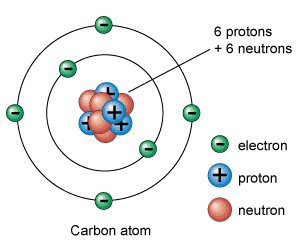
If that isn't bad enough, think about the lie we are spilling when we draw these particles on the board. 
This is nothing like what an atom looks like! First off, representing the particles as small spheres is a misrepresentation of what they truly are. What is an electron?.... Its a quantized amount of energy that has a charge of -1.6E-19 Coulombs. It has mass due to its interaction with the Higg's Field giving it a rest mass of 9.11E-34 kg, which changes as it moves. Does an electron have a volume? I have never seen that figure. We know it is localized, but to draw it as a small sphere is completely misleading. The nucleus is worse! It is drawn as a jumble of protons and neutrons, vibrating around each other. Technically is should be a soup of quarks waving in and around each other. Do quarks have a volume? Hard to tell.

Chemistry teachers know that electrons don't orbit like planets as they do in the previous picture. Electrons exist somewhere in orbitals (which for all we know are just mathematical probabilities) that surround the nucleus. In fact, they appear to exist everywhere at once. Why do we draw them as planetary orbits? Well there is a reason. That model explains spectroscopy very well. Students can visualize electrons jumping from one orbital to another. This was worked out a century ago by Neils Bohr. This was his model... 100 years ago! 

The scale of that picture of an atom is also completely off. Electrons have 1/2000th the mass of a proton, and the nucleus is WAY smaller than that. As a matter of fact, most of the volume of an atom is empty space. Try discussing the real scale of an atom with students. Since I am made of atoms, and atoms are basically empty space, does that mean that truly I am not here? If I am basically empty space, and the desk is empty space, why can I not pass my hand through the desk? What does it mean to feel something?

Objects are tangible because that empty space (electron orbits mostly) are filled with a few electrons. That makes them negatively charged. The negative empty space in the desk repels the empty space in my hand and thus I can not put my hand through it. In fact, the reason you can see your own hand is the interaction of photons from the lights with that empty space, exciting atoms until they release photons that you can see. 

Never lie when it sets up a misconception. 
Many would argue that any of the above lies would set up some misconceptions for a student's future understanding of these principles. Most of my hedging of the truth is due to the speed at which I have to cover material. I am very careful to mention many of the above aspects of nature at some point in the year so as to clue them in on what comes next, but many times it is cursory. 

We need to be very careful about setting up misconceptions in students. As the above conversation notes, I am not alien to this idea, but there are things that I have seen that concern me. Elementary text books need to be VERY closely scrutinized. I understand not telling a 3rd grader the whole truth about an atom (I don't even stress this to my high schoolers). What I can not overlook is when my son's textbook tells him that mass is anything that takes up space. This is setting up a harsh misconception between mass and volume. What compounds this is the fact that many elementary teachers are not confident enough in the science to know the differences. They rely on that book for their information and may not have the concept separated in their head. This may be a harsh example, but it happens more often than I ever imagined. 

What lies do you tell, or what have you seen?

Chris
@christopherlike


Monday, March 11, 2013

Gamifying a Classroom: Step 2

Earlier, I posted that I have been looking at applying the principles of gamification to a classroom experience for my students. I started with the idea of revolving the class around a Star Trek-like world where students would be earning ranks by fulfilling achievements. I began a website here.

I am planning this for my Astronomy class, in a unit that is rough for them. The underlying topics to be covered are Electromagnetic Radiation, Spectroscopy, Doppler Effect, and Telescopes. It is basically the "science" part of astronomy in terms of what principles astronomers use today.

The basis behind the game is that students will enter a classroom that is to prepare them to be the captain of their own starship. They begin the game as Cadets, graduate to Ensigns, then Commanders, then finally Captain. You can read more about this on the site or the previous post. 

I have worked out a pretty cool advancement tool that I am going to incorporate. I plan on taking some safety pins that they can attach to their school issued lanyards. Upon completing a level, they will be given a bead to place on the pin (think cub scouts). The color of the bead will indicate their level of completion. For instance. If they pass their advancement exam on their first attempt they will be awarded the title Cadet 2nd Class (Blue Bead). If they complete the enrichment exercise, they will advance to 1st Class (White Bead). If they fail their bar exam, but pass it on their second attempt, they will be considered Cadet 3rd Class, but can move up to 2nd Class by doing the enrichment exercise.

Thus by looking at their pin, they have their rank right on their chest.

0 beads - Cadet
1 bead - Ensign
2 Beads - Commander
3 Beads - Captain

1st Class White (Passed test on first try and completed enrichment)
2nd Class Blue (passed test on first try)
3rd Class Yellow (Failed test on first try but then passed)
4th Class Red
5th Class Black

Let me know if you think this is a good idea or if you have something that will make it better. I am seriously thinking about trying this in late April with my astronomy class. It will take a lot of work re-writing labs and resources to give them a Trekky feel, but it is timely with the reboot of the movie franchise. I will post more when I have more. Any feedback on the development of this would be appreciated.

Chris
@christopherlike

Wednesday, February 13, 2013

The Importance of Having a Pedagogy

California scares me. They have tried to pass a law (maybe they did) that says that anyone with a college degree can teach for a few years. Sounds great on paper. You have a bunch of engineers who can't find work in Silicon Valley after the Dot Com Boom of the nineties. Throw them in a classroom and let their expertise in science and engineering drive the curriculum. This scares me. Good teaching is more than knowing the equations in the homework, or how to place a prepositional phrase in a sentence. Good teaching involves a knowledge of how kids learn.

I realize that there are many factors that go into being successful in the classroom (personality, relationships, content knowledge, confidence, and work ethic). I may hit on some of these in later posts, but today I want to discuss planning the lesson. Great teachers have a method to their madness. They have a base set of ideals and beliefs that govern how they teach. They have studied both before becoming a teacher, and more importantly while in the act, how students best learn material. They pay attention to the group as a whole, but know that there is no silver bullet that can catch every student. Their lessons do not write themselves, and rarely are written by another. They steal, develop, or create the lessons that work best for them. They talk with each other, and are open-minded enough to try something different or adapt their perception of learning with changing demographics of students. 

Let me give you the secret to my teaching. The biggest push in science right now is this thing called Inquiry Learning. What is interesting is that with all the books written, articles published, buzzwords created, standards carved in stone, and legislation passed, I can not adequately define it. Talk to two different people and they will tell you it means two different things. Here is my definition of inquiry. Any lesson that forces kids to think, is an inquiry lesson. When I say think, I mean solve problems, analyze situations, or come up with conclusions based on data. Memorization, matching, or any rote learning is not inquiry. (I don't want to downplay rote learning as there is a place for that too. Sometimes we spend too much time on having kids make inferences, and not enough time on them actually understanding premises of problems.)

The Learning Cycle

When it comes to tried and true methods of teaching, few stand up to the learning cycle. It has been around for something like 30 years, peer reviewed in numerous research scenarios, and updated through more dissertations than I can count. I was weaned on this method in college as the University of Northern Iowa's physics teaching department used it as the basis for much of their products. (PRISMS, CRISTALS, BIOMES, etc)

There are many different types of learning cycles out there. I use the simplest as it allows for the most flexibility. ALL of my lessons have these components to them, in ALL of my classes. This is how I teach, and I believe it has been successful. I have applied this from my AP Physics to workshops with kindergarten teachers who stated "Why had no one ever told us this before?!"

Step 1: Exploratory- This initial part of the lesson is where you give students a common experience. It may involve a lab in chemistry where you have students make patterns of shapes that will lead you into a discussion of the periodic table. It may be a 1st grade teacher taking her students on a walk and then having them discuss anything that they noticed that was affected by the weather. 

Step 2: Concept Development- This aspect of the lesson is where you take the common experiences that student have been given and expand them to the concepts you want them to understand. This may be a lecture, a lab activity, or any other aspect that many would say is normal teaching. More often than not, for a science classroom, it is an activity (or set of activities) that is much more pointed than its exploratory counterpart. The questions are expected to push the student towards understanding the concept. In physics, after students have made graphs of motion and recognized that the slope is related to the velocity, these activities have them calculate the slope or even look at the area under graphs. 

Step 3- Application- At this point the instructor should be fairly confident that the students understand the material. But can they apply it to a new situation? Imagine 2nd grade students who did connect the dots on a set of constellation worksheets for exploratory and learned stories behind constellations in concept development. Can these students then make their own constellation out of given stars on a sheet? Can they make their own story about how it got into the sky? This may be the most often overlooked part of the cycle (time is always and issue), but it is probably the most important.

Chris
@christopherlike

Friday, February 8, 2013

Mission to Mars Activity

Last week our school was give the unique pleasure of hearing from one of our graduates through our Visiting Scientist Program. Jeff Hanley has been a director at NASA for many years, serving as flight commander in mission control on several missions including the repairs to the Hubble Space Telescope and the construction of the International Space Station. He spoke at some length on the challenges faced when we set our sights on Mars. Even for me, an astronomy teacher, it was eye-opening.

For many years I have done a project in my Astronomy class dealing with placing a base on the moon. This was very timely when then President Bush rallied our engineers to go back to the moon as a stepping stone to Mars. Unfortunately (especially for Hanley as he was director of the project) now President Obama has shifted NASA away from Moon exploration.

I am shifting the project towards a Mission to Mars. Here is how it works.


  1. I break the class into three groups, two large Engineering Firms and one Mars Mission Council consisting of three students. I choose the groups ahead of time taking care to know who works well together and who the class will accept as their Mars Council. 
  2. The job of the Engineering Firms is to come up with a plan on getting to Mars. There are usually about 8-10 in a group, which seems large. The task is large and they need all the manpower they can get. Their elected Chief Engineer sets smaller groups to solve the problems with air supply, food, transportation, waste management, recreation, etc.  
  3. The task of the Mars Council is to grade the projects. Part of the Engineering Firm's grade is based on whether their proposal is accepted by the Council (10/60 of the points for the activity). The Council spends their time making rubrics, deciding how long the presentations will be, creating questions for the groups after their presentations, and answering process questions from the groups. They are in charge. 
  4. I move the Council to a completely different room and set them up with a computer. They typically create a generic gmail account for their Council that they can share documents and answer emails from the groups. If one of the Firms has a question about their proposal, they can email the council. The Council can choose to answer if they want too, or ignore it. That is real world. The Firms can not directly talk to the Council. 
  5. I will only talk to the Chief Engineer from each Firm. This sets up a real-life bureaucracy that students begin to get exposure too. 
  6. I set up some focus questions for them online to drive some decisions that need to be made about the Mars Mission. 
  7. They get about three days (full blocks) to work before they give their presentations. Most groups dress up for the presentation, make scale models of their bases, and try to 
Here is a link to the website that I am using for Astronomy. At the bottom is the link to the Mars Mission Project. It has worked really well with the "Moon Lairs" that they have made in the past, I am excited to see if going to Mars will offer more challenges. 

Chris

@christopherlike

Tuesday, February 5, 2013

Gamification with Students: Galaxy Fleet

Alright, this is a bit out there, so try to read through the whole thing before passing judgement. I will tell you that this is only an idea, still in the "It may be cool if I try this someday" stage. It may be something great or may fail miserably. Hard to crystal ball that kind of thing.

If you read my previous post on Gamification, you were introduced to using game dynamics in a non-game setting. I have done this for staff PD and it has been very successful. This is my first attempt at planning something for students. After talking with our Physical Science teacher Breelyn McMahon, I tried to develop a unit based on a game. She encouraged me to include some standards based grading, which I think was a great addition to the concept.


Here is the premise for a physical science unit on Electromagnetic Radiation. The students start out as Cadets training for Galaxy Fleet- a futuristic military academy. (I am trying to give this a Star Trek feel.) They begin by being trained to become Communications Analysts (Ensigns). In order to gain this recognition (which I plan on doing with virtual metals) they need to pass their bar exams. These exams would consist of three quizzes, one conceptual, one multiple choice, and one mathematical (or performance). I basically broke the unit exam into three parts. They have to pass at least two parts with 75% or they have to retake them. After becoming an Ensign, they strive to pass on to Commander, and then Captain of the ship.

In order to even take the Ensign exam, they have to earn "commendations." These are earned by passing standard classroom activities. If a student finishes a lab, they earn a commendation...  if they finish their homework, they earn another, etc. Once they have 3 commendations, they can take their bars. If they fail one or more aspect of the bar, they lose a commendation, which must be then earned back before they can retake the exam. This could be done with a remedial lesson or worksheet to review what they need to know to pass that part of the exam.

The lessons are all based on the Learning Cycle approach. Students will earn a commendation for their exploratory activity, their concept development activity, application activity, homework and such. The lesson would be planned and executed with sound science teaching methods of discovery and inquiry.

Here is the basic outline of how they could become an ensign.


  1. Pass the "Lost in Space" exploratory lab to learn types of ways in which we can communicate (what a wave is) 
  2. Pass the "Keeping Time with Pendulums" lab to learn vocabulary (amplitude, wavelength, frequency, etc)
  3. Do some homework associated with the previous
  4. Pass the "Wonderful, Wonderful Toy" lab with Slinky springs to understand the types of waves out there as well as reinforce vocab.
  5. Earn 3 commendations and take their bars. If they pass 2 out of 3 of the formative quizzes they reach Ensign and they do the application activity "It Sounds Good, But What Does it Mean" lab with standing waves. 
  6. If they fail a part of the bar, they do some remedial worksheets to earn back the commendation to take the bar until they pass. As these students are doing this, the ones who passed will be working on the application. 
  7. To get them all at the same level, we added an extension activity for the ones who passed to do while the others are doing remedial work and retaking the bar exams. 


Those set of activities would cover one standard in the unit. As a Com Analyst they will be exploring more about electromagnetic waves until they take their exams to become a Security Specialist (another standard in the unit). After that they will be applying what they know the to lasers on the ship, reflection, and refraction of materials to protect the vessel (a last standard in waves). If they pass out of that they can take their overall exam to reach Captain status.

Here is a link to a website I began to make for this. I included some preliminary lab activities and a description of the game. Note the feel of the writing. I may expect them to call me "Sir" as their commander and ask them to stand at attention when I enter a room, etc. Maybe I will wear a ribbon or jacket or something. It may be fun (at least for me). I envision having ceremonies at the beginning of class when someone earns their new rank, maybe having a website with kid's profiles/rank/commendations/etc to allow them to showcase their accomplishments.

This would cover maybe three or so weeks of class (on a full block each day), with exams at the end of each week. Some of the activities take 10 minutes while others may take a full day. The quizzes would be designed to last about 15 minutes each with the Captain's exam (the comprehensive one) being a full exam at the end of the unit. They can't progress unless they show they have met earlier standards on the formative quizzes though.  

The idea would be that the next unit in the class could be based on a different theme. I think students would get tired of Star Trek for 9 or 18 weeks. Perhaps we do a medieval theme, or spies depending on what the unit is. A unit on chemistry would be great for a detective/forensic angle, and a unit on motion could be done with designing roller coasters.

That's it!

Any thoughts would help in doing this. Do you think students would like it or hate it? Any ideas for adding to the game? If I didn't explain it well enough, please comment and I can try again.

As I plan to do a lot in this blog, I am just throwing out ideas. If you like it, run with it and let me know how it goes. I am still on the fence on this one as it will take a lot of time to put this into use.

Chris